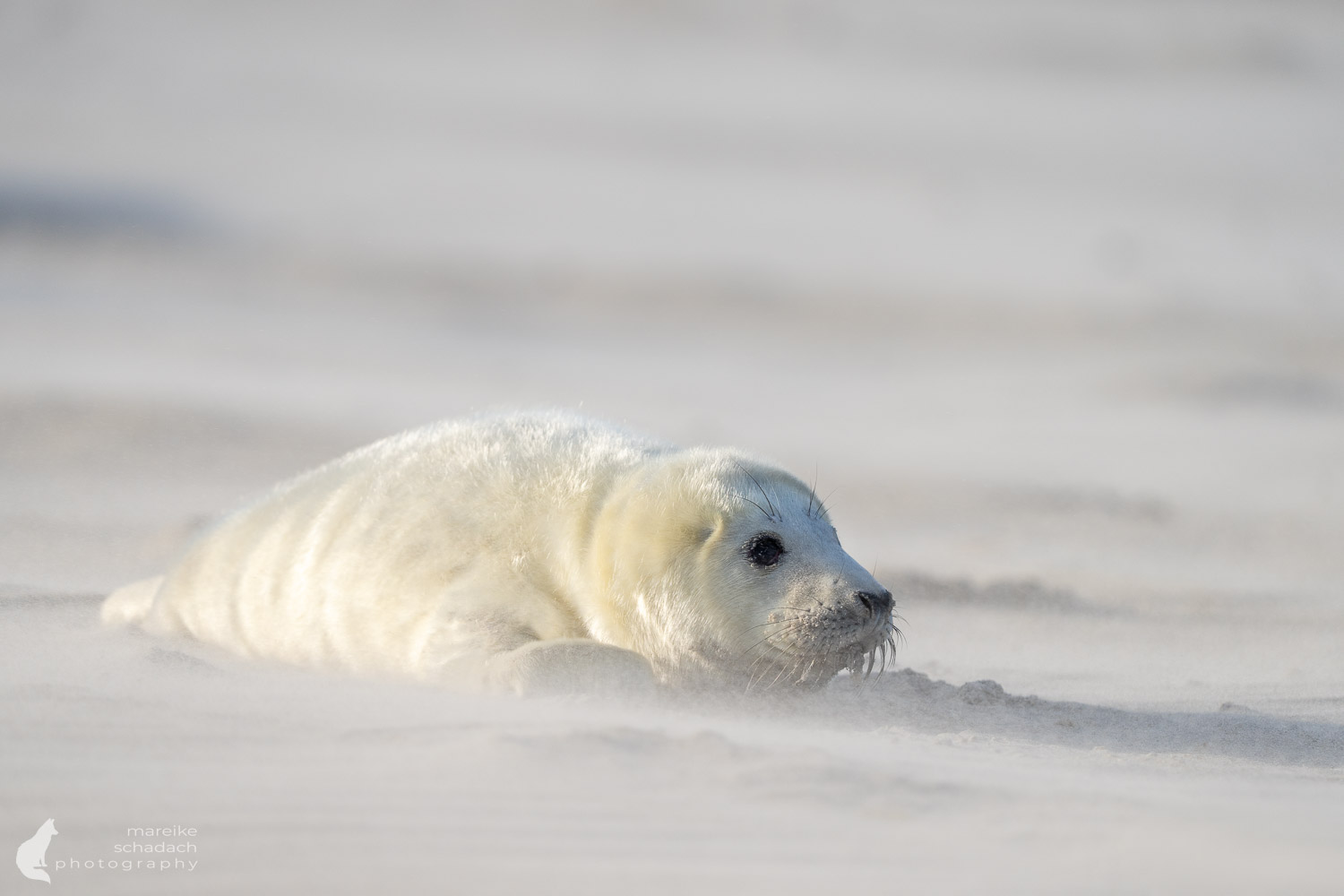
Germany. It is early December. The two-and-a-half-hour ferry crossing from Cuxhaven to Heligoland can be a wild ride at this time of year. But right now, something very special is attracting many nature lovers to Germany's offshore island: the birth season of the gray seals. From November to January, hundreds of gray seals are born on the flat sandy beaches of Heligoland Düne. It's a natural spectacle that is second to none.
I am spending three days on Heligoland to photograph the seals. I am hoping for one of those rare moments that nature photographers dream of: a birth. In the following, I will tell you about my time with the gray seals and give you lots of practical tips for your own photo trip to the seals on Heligoland Düne
Unassigned, unpaid advertising. The article contains affiliate links.
New Life among the Gray Seals
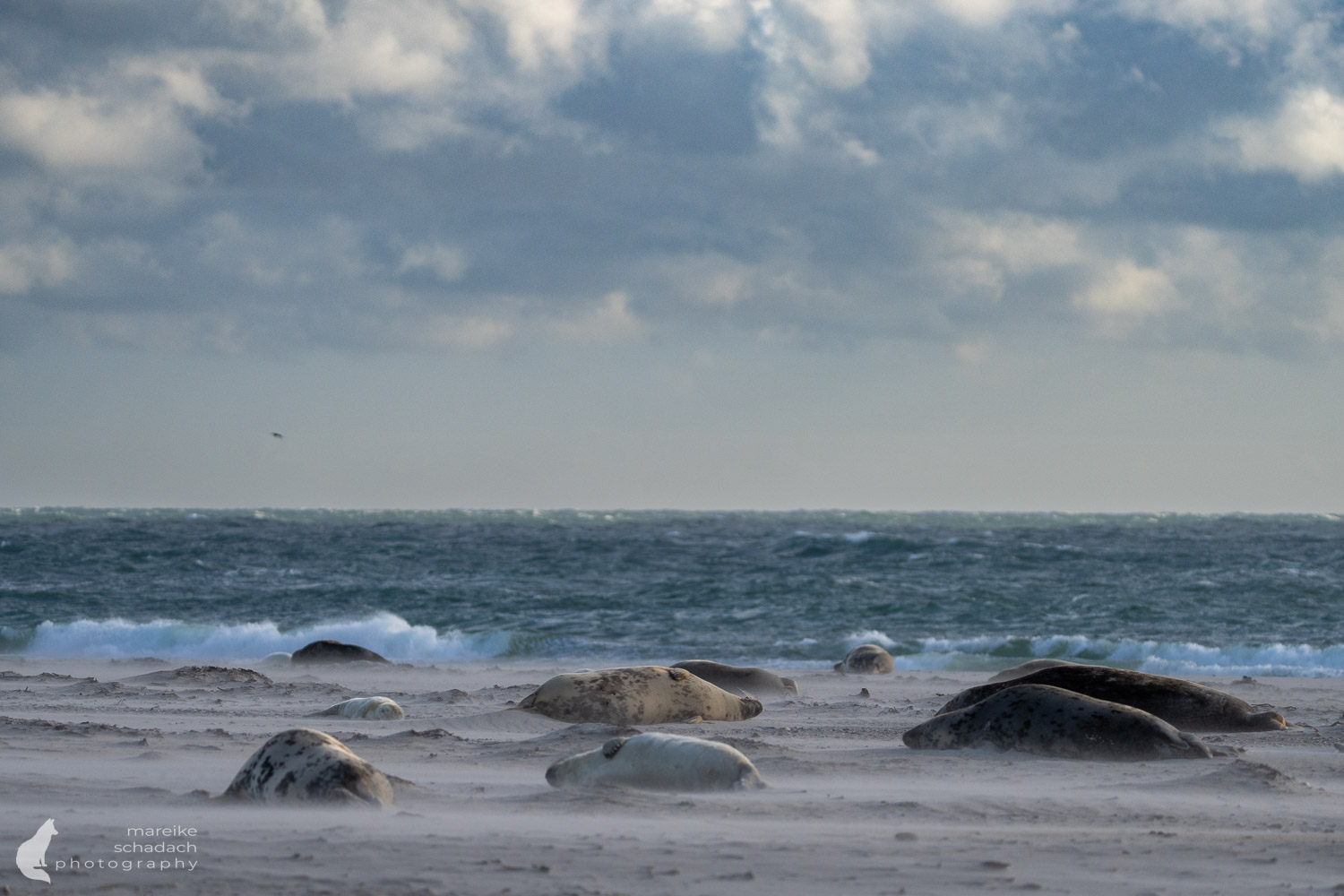
The wind has a firm grip on the Heligoland dunes. Fine sand whips across the beach, drawing bright veils across the ground. The grains of sand hit me like tiny needles and crunch between my teeth. I am glad I have my safety goggles from the hardware store, which allow me to keep my eyes open without straining them. My gaze and my camera are fixed on a large gray seal that is behaving conspicuously nervously, not far from the barrier fence. After a few minutes of sand exfoliation, my suspicion is confirmed: her abdomen reveals a bulging red amniotic sac.
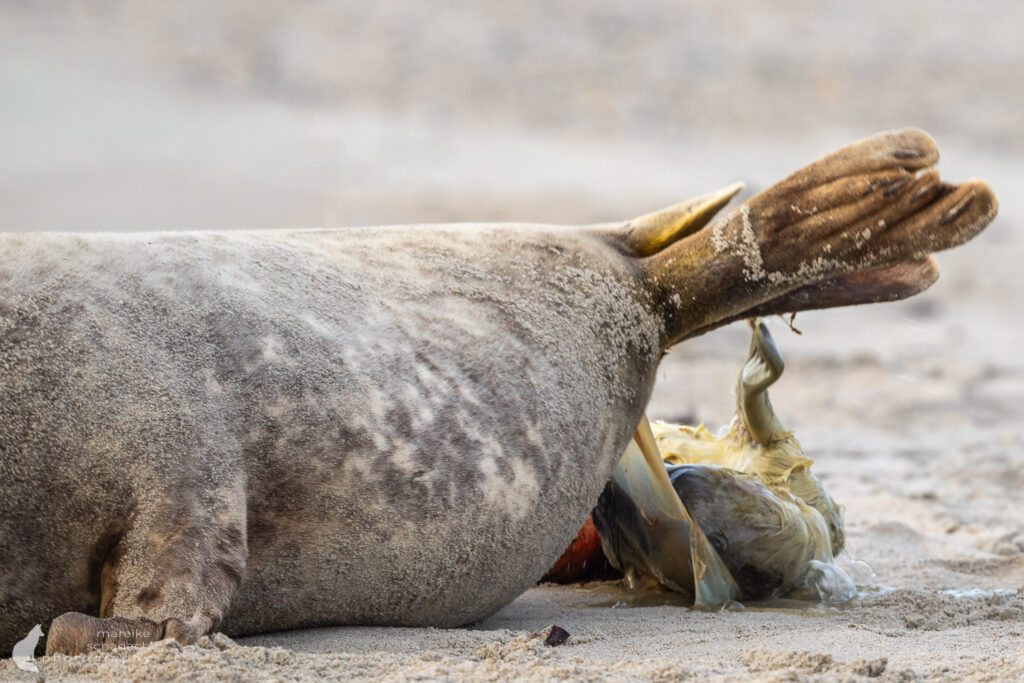
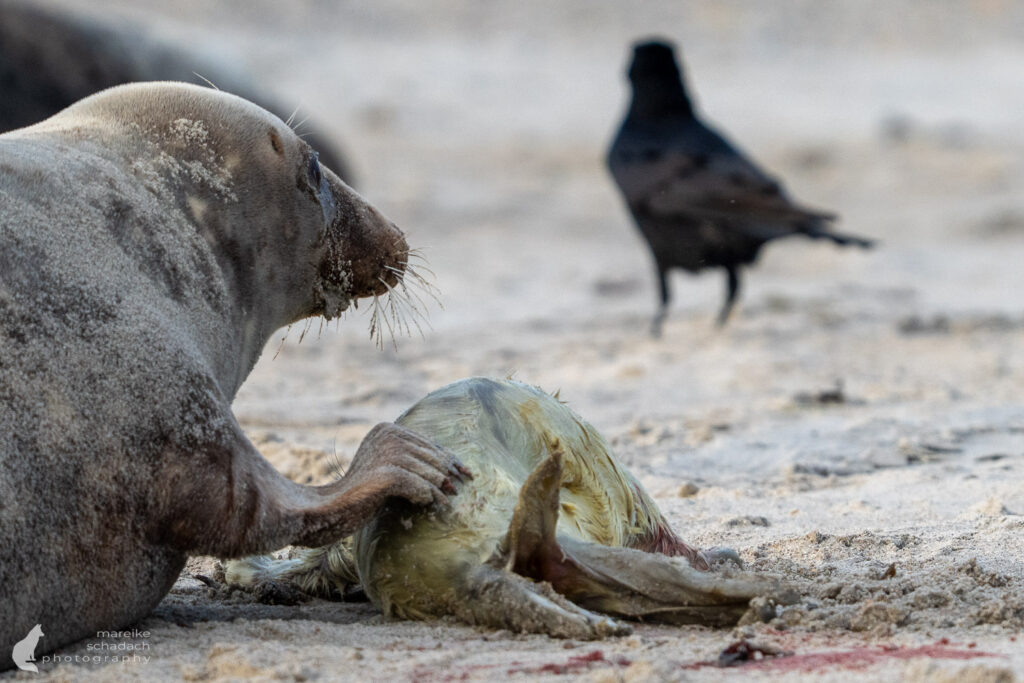
The female turns awkwardly onto her side, first one way, then the other. She bends like a banana, turns in circles, and tries to push the amniotic sac further out. The surrounding seals raise their heads, unimpressed. The offspring takes its time. For about 15 minutes, it hangs halfway out in the fresh North Sea wind of 7 Beaufort, while its mother twists and turns, bends and rolls in circles. All without making a sound, less than two meters away from the mobile barrier fence that separates visitors from the wild animals. All observers keep a respectful distance and watch. Also, without making a sound. Then suddenly everything happens very quickly, and a wet, yellowish bundle lies in the sand.
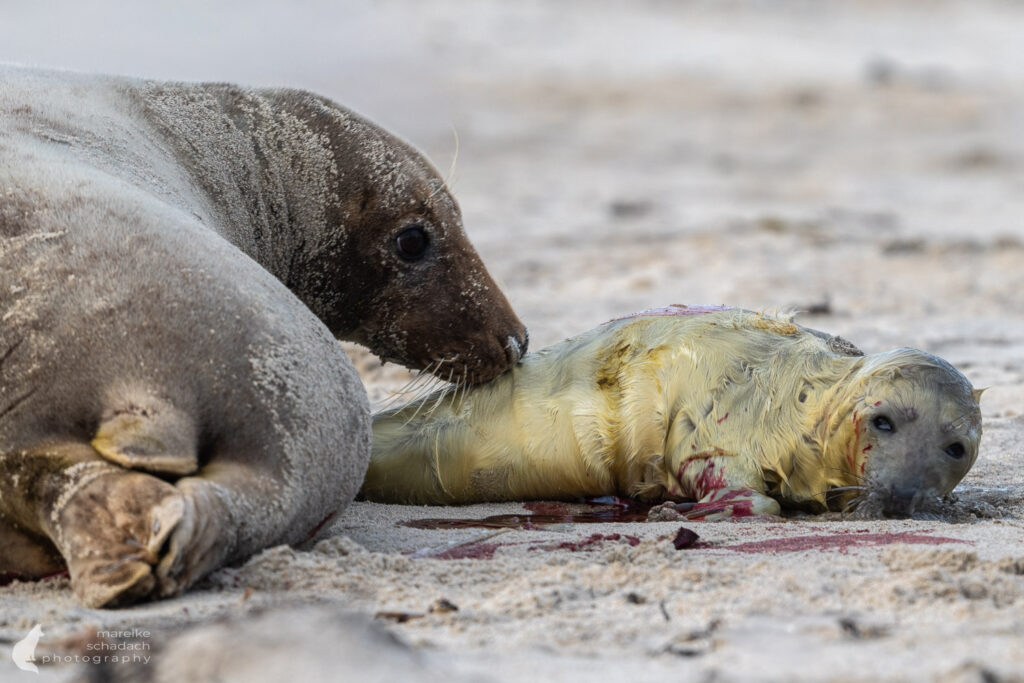
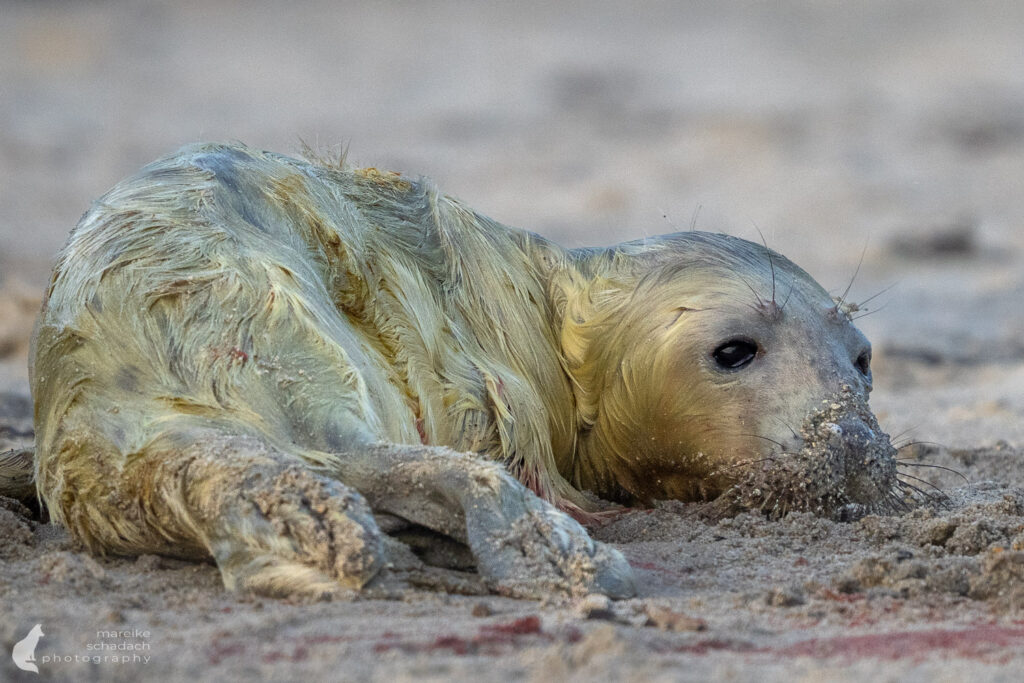
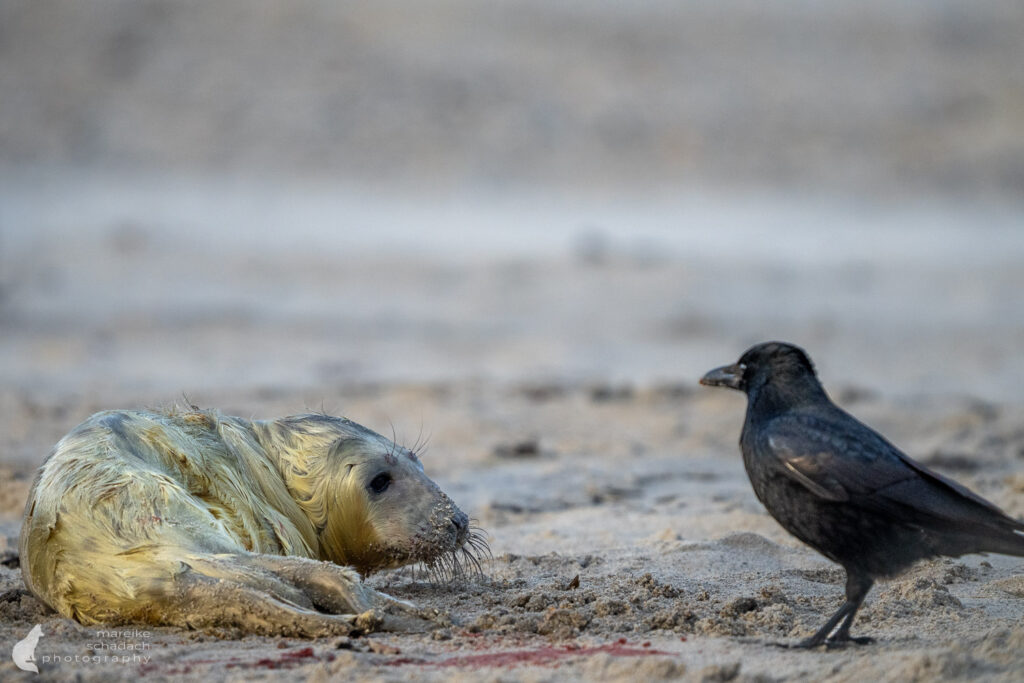
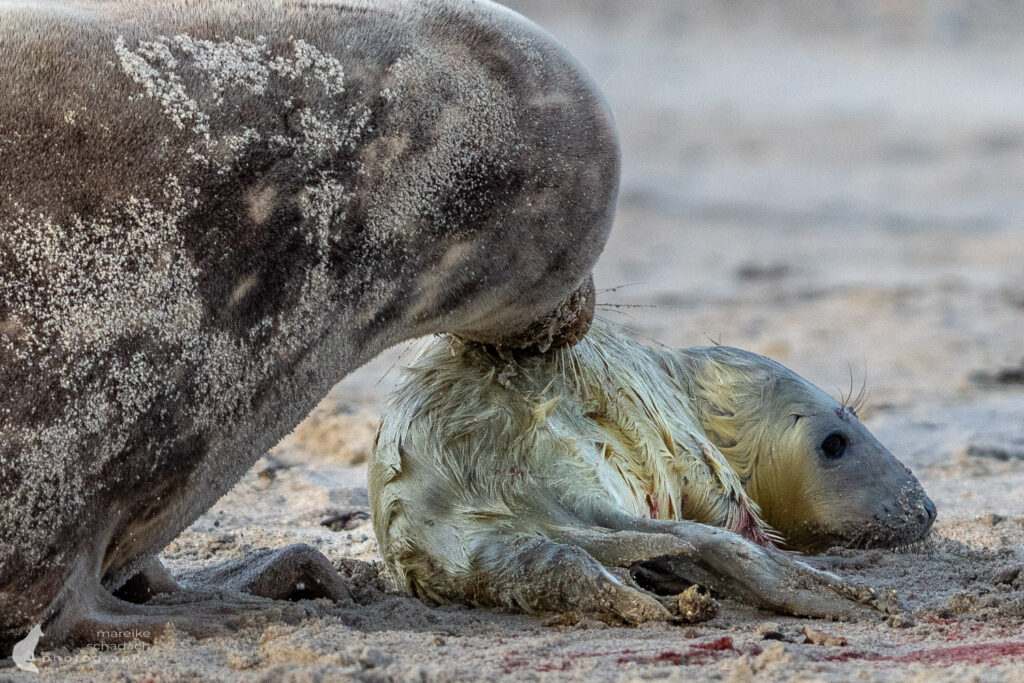
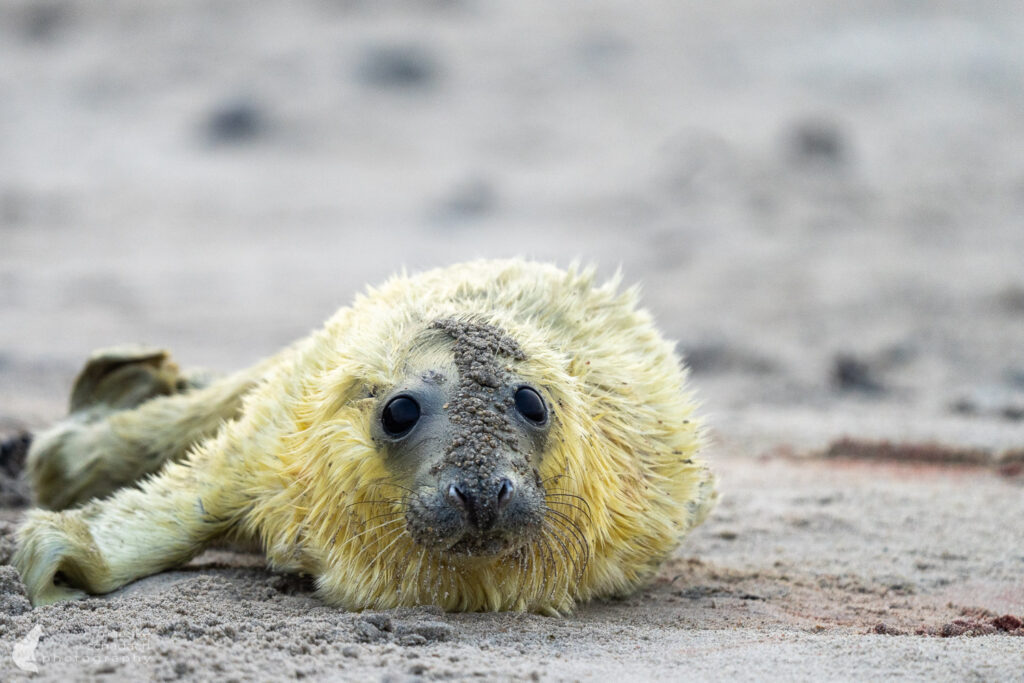
The little seal pup immediately opens its eyes and is sniffed and touched by its mother. Moments of closeness, simply beautiful to watch. Meanwhile, the crows jostle in front of the placenta before it cools down and is covered with sand. A wild feeding frenzy begins. The calf looks at the world with its big black eyes, somewhat irritated. Can it already see the crow right in front of it clearly? Can it see us photographers? Its first movements seem shaky, tentative. It takes a while for the little one to find the milk teats and for its fur to dry. Now it is no longer yellowish, but shows its beautiful white lanugo fur. A piece of the fresh umbilical cord still hangs from its belly.

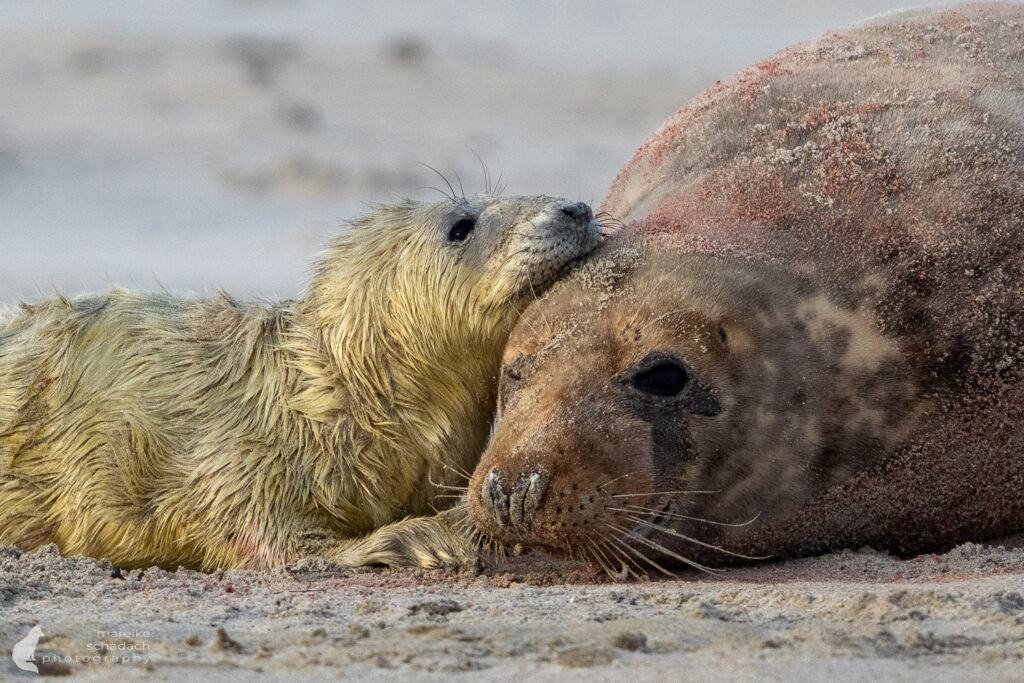
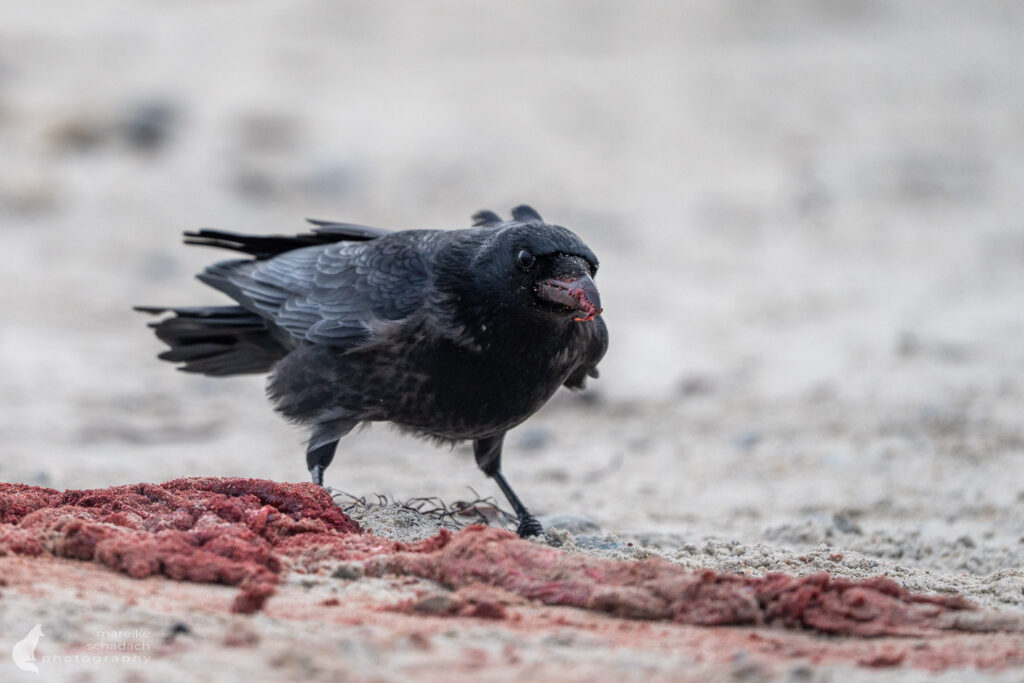
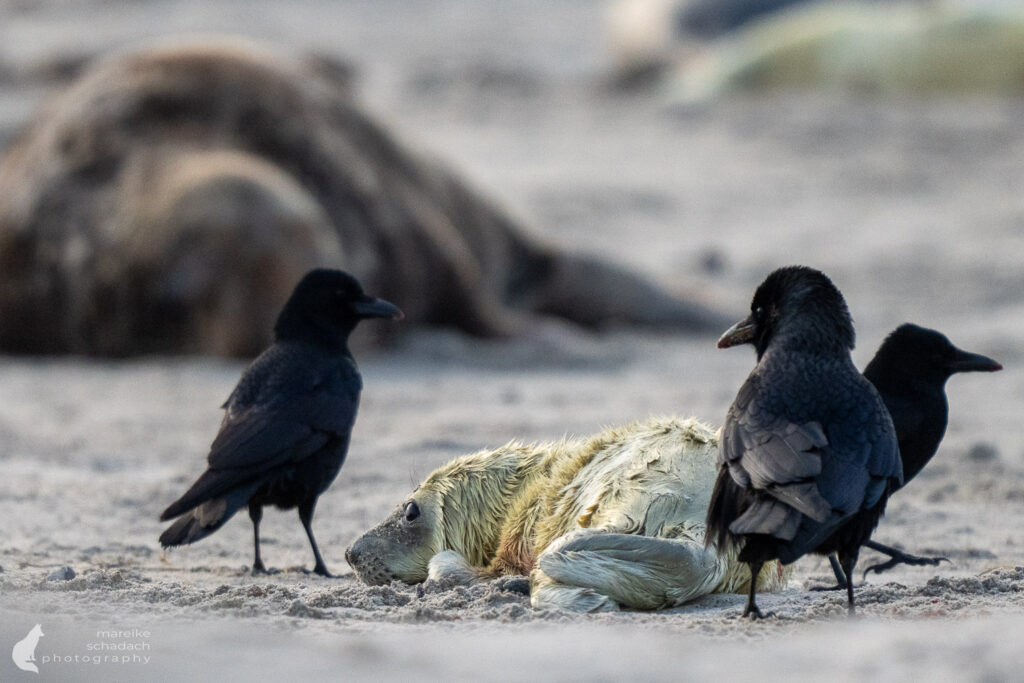
Growth in Record Time – From a white Ball of Fur to Germany's Largest Predator
Seal pups are born weighing around 10 to 14 kilograms. Due to the fat content of their milk, which is more than 50 percent, the pups gain up to two kilograms per day and soon develop a thick, white layer of blubber. Some mothers stay with their calves permanently, while others leave their young alone for a few hours to go fishing. When the calves are weaned after 15 to 21 days, they are on their own. About ten days after weaning, their fur changes, and the white woolly coat is replaced by a swimming coat. Then come the first attempts at swimming, and the young seal begins to hunt instinctively.
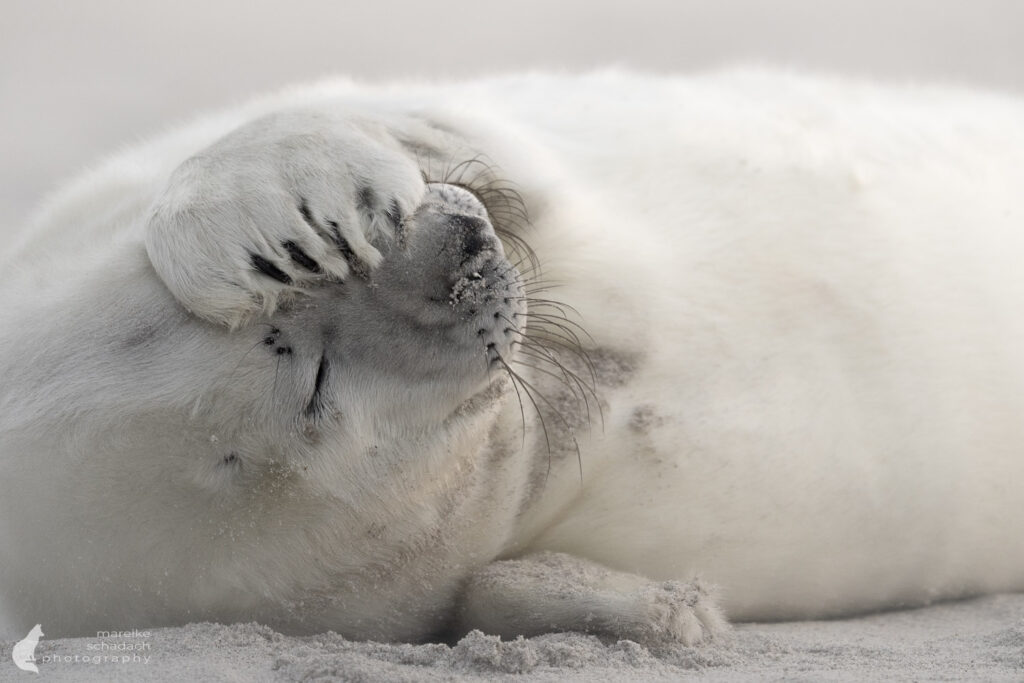
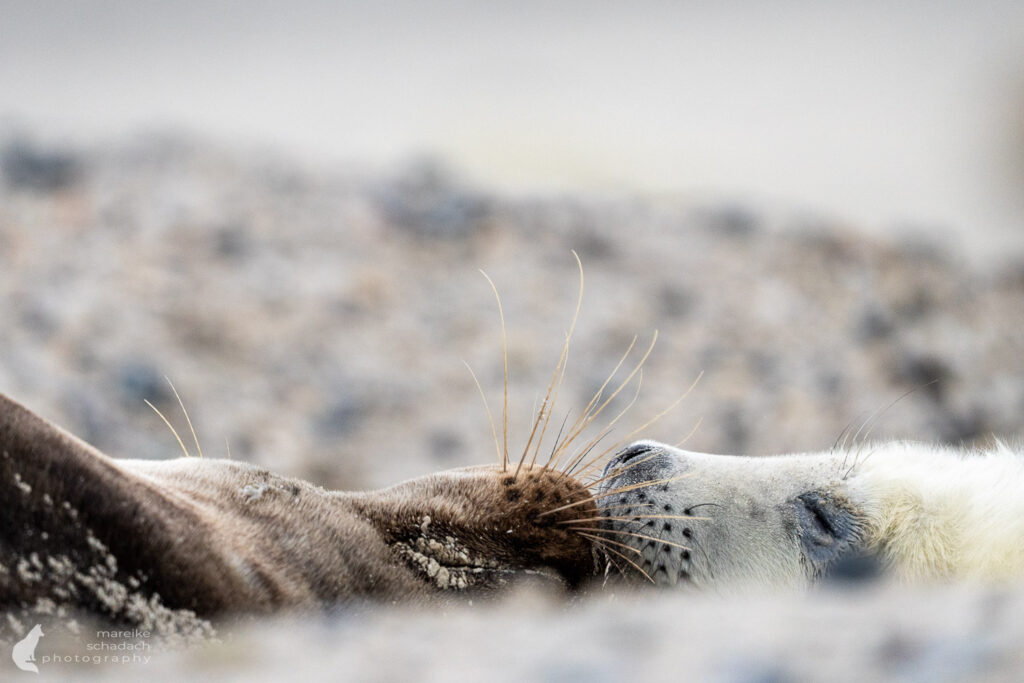
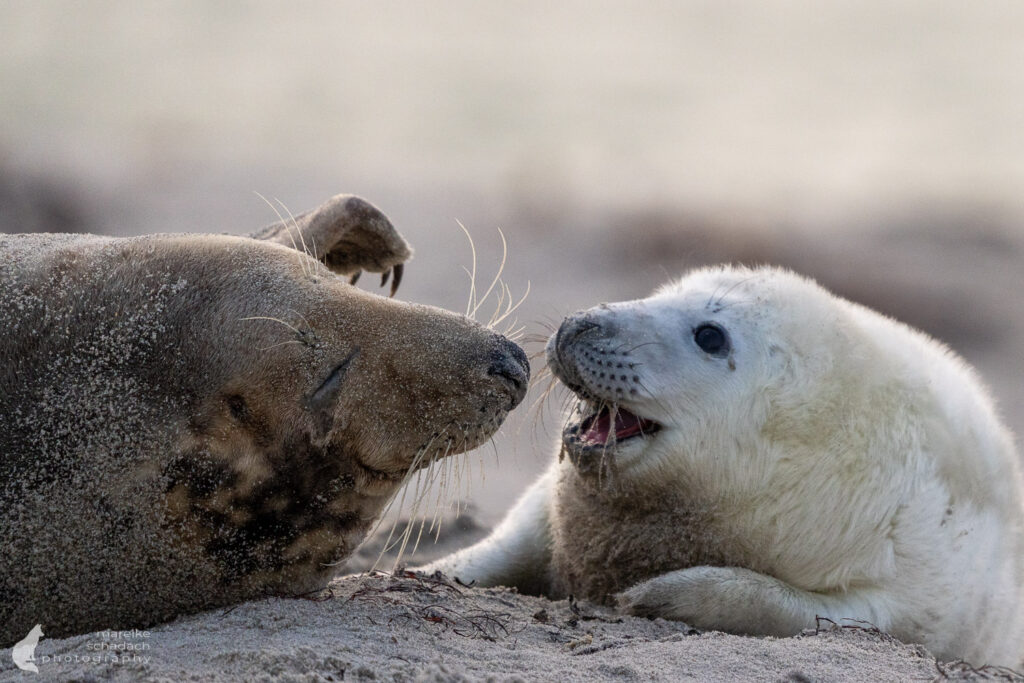
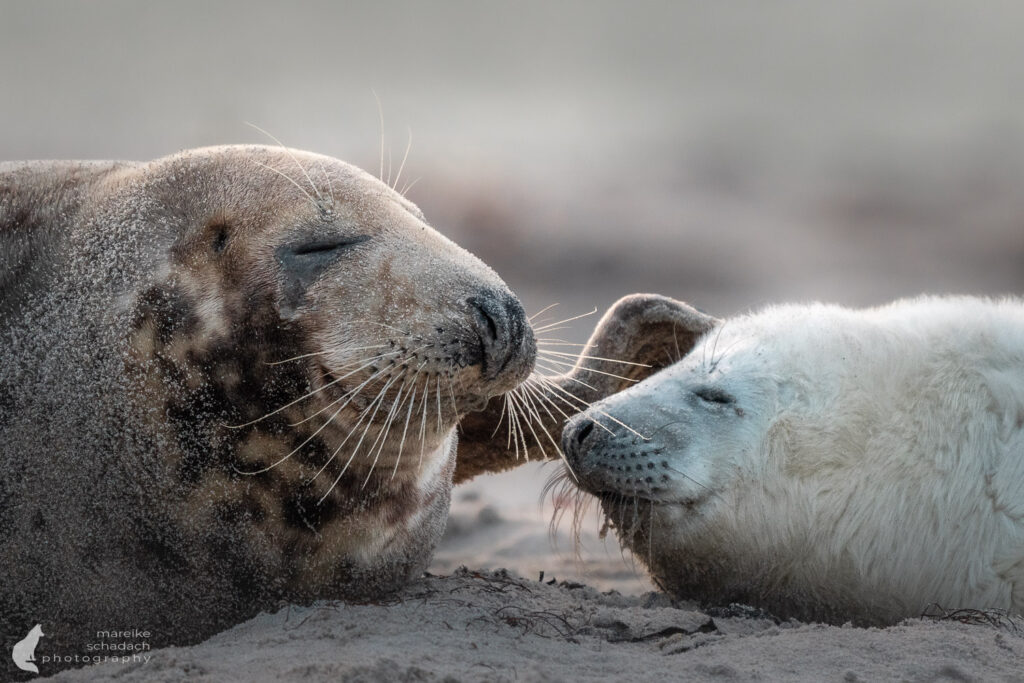
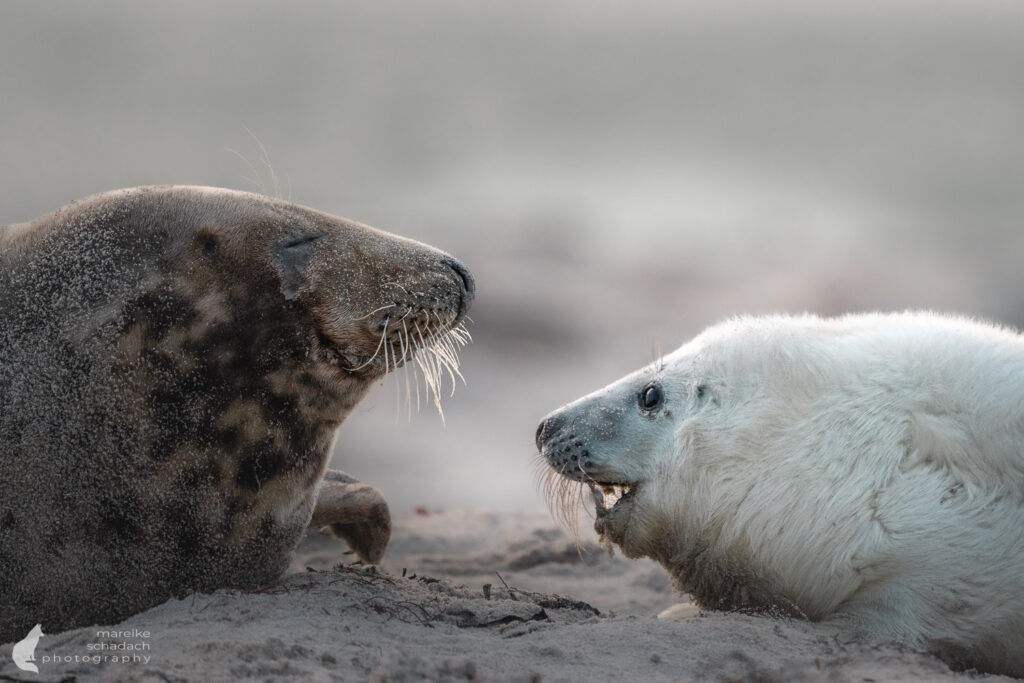
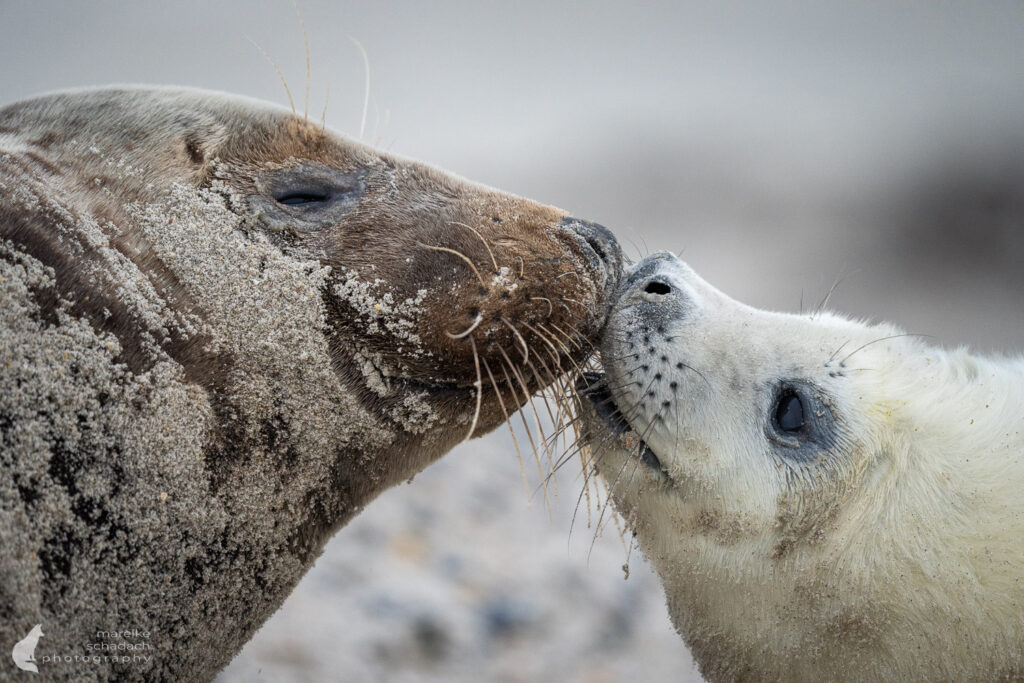
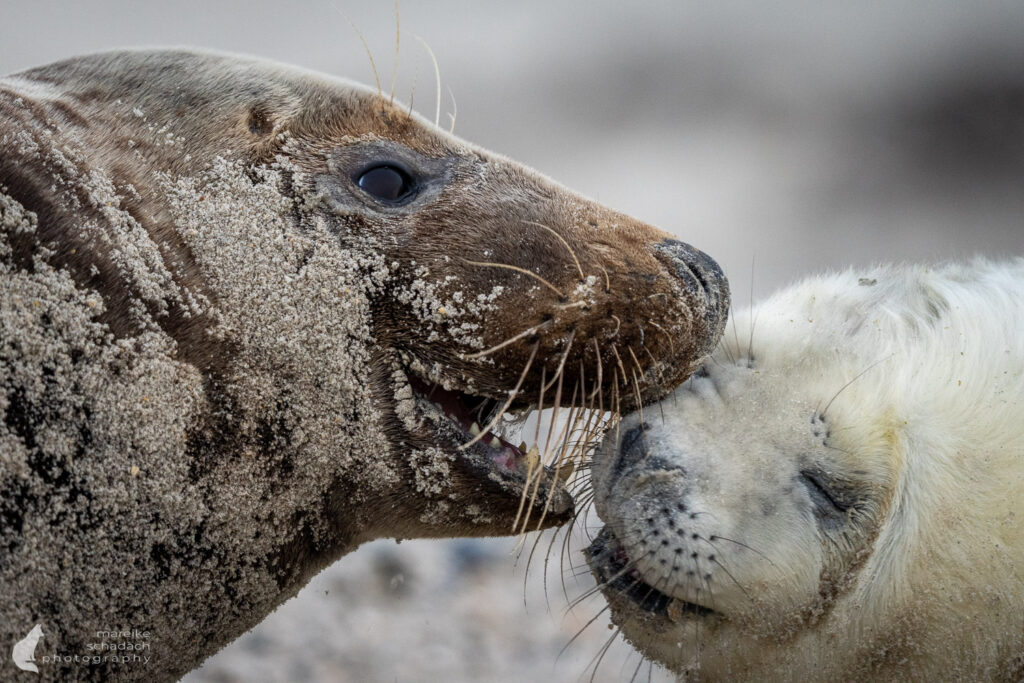
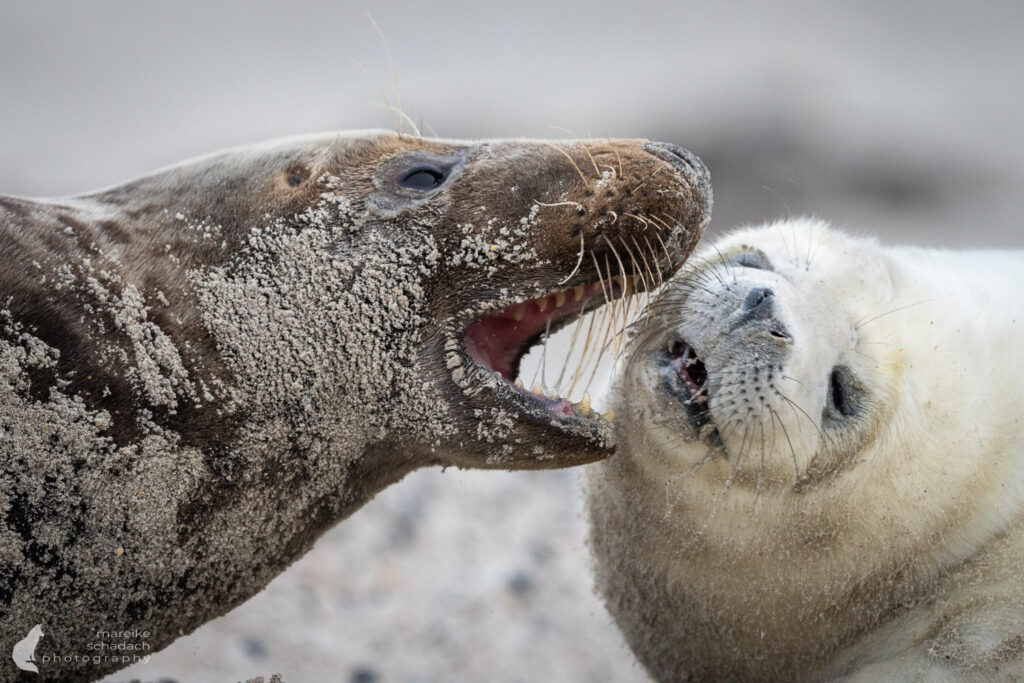
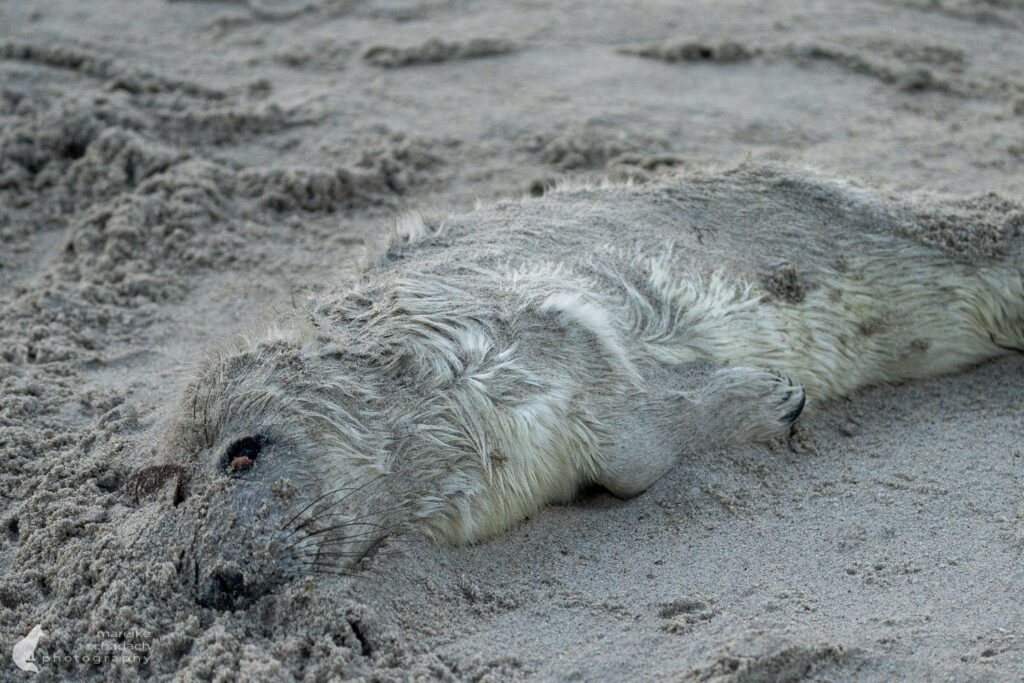
On the beach, I see young animals that are only a few days old and others that have already become little rolls of blubber. They seem extremely clumsy on land, but are already very curious. They explore with their snouts, feel their way with their highly sensitive whiskers, and turn their heads toward every new sound.
Grey seals belong to the family of dog seals. Their range extends from Norway to the East Coast of America. The animals that come to Heligoland belong to the eastern North Sea population. They are the largest predators in Germany:
- Males can weigh up to 300 kilograms. They only reach their full strength at around eight years of age.
- Females remain significantly smaller, weighing between 150 and 200 kilograms.
- Young animals weigh between 10 and 14 kilograms at birth.
- The average life expectancy of a gray seal is 35 years.
- Gray seals can reach speeds of up to 20 km/h on land and up to 40 km/h in water.
- Estimates of the survival rate in the first year of life vary greatly depending on location and conditions, ranging from less than 50% to 85%. The main causes of death are often starvation or injury.
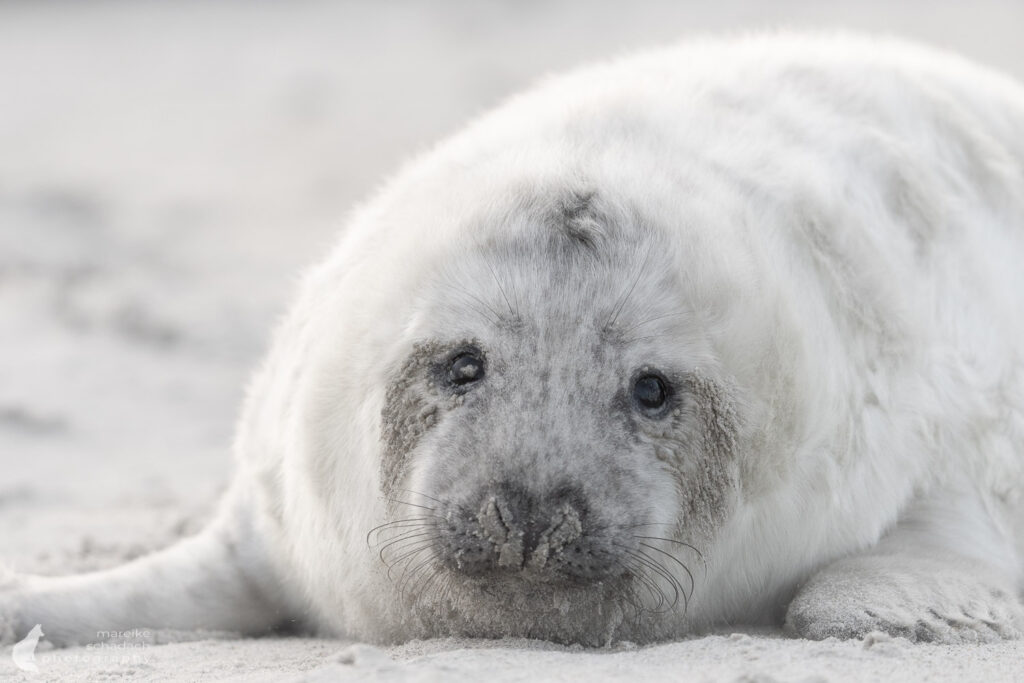
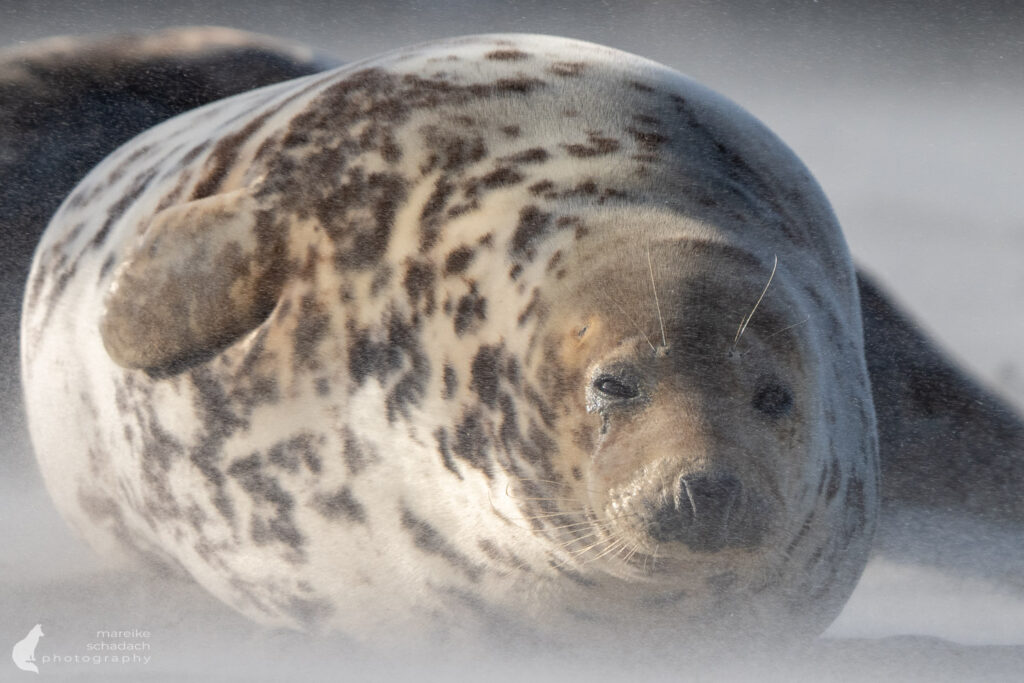
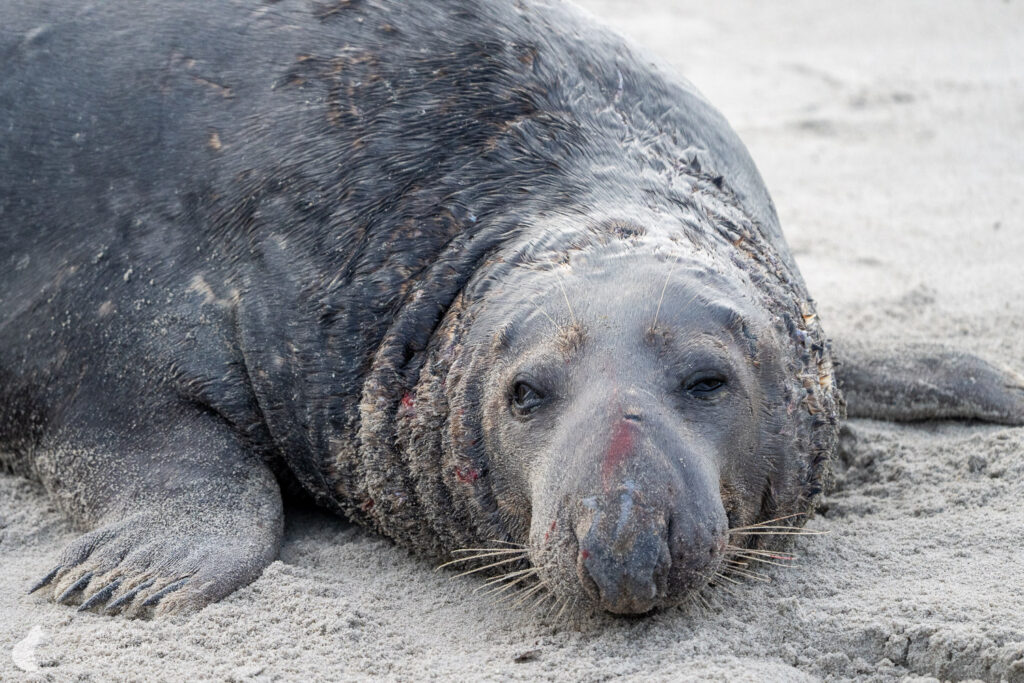
Deutschlands wohl stürmischste Kinderstube
Heligoland Dune is barely recognizable in winter. The summer vacationers are gone, leaving behind silence, wind, and Germany's largest gray seal colony. Every year starting in November, this beach becomes the most important birthplace for the eastern North Sea population of gray seals (Halichoerus grypus).Halichoerus grypus).
What appears to be a barren place is in fact a perfectly functioning nursery:
- Strict social distancing rules and barriers separate visitors from the animals.
- A wide beach that is never completely flooded.
- Vigilant rangers keep an eye on seal pups in need of help and keep an eye on visitors.
- Waters rich in fish.
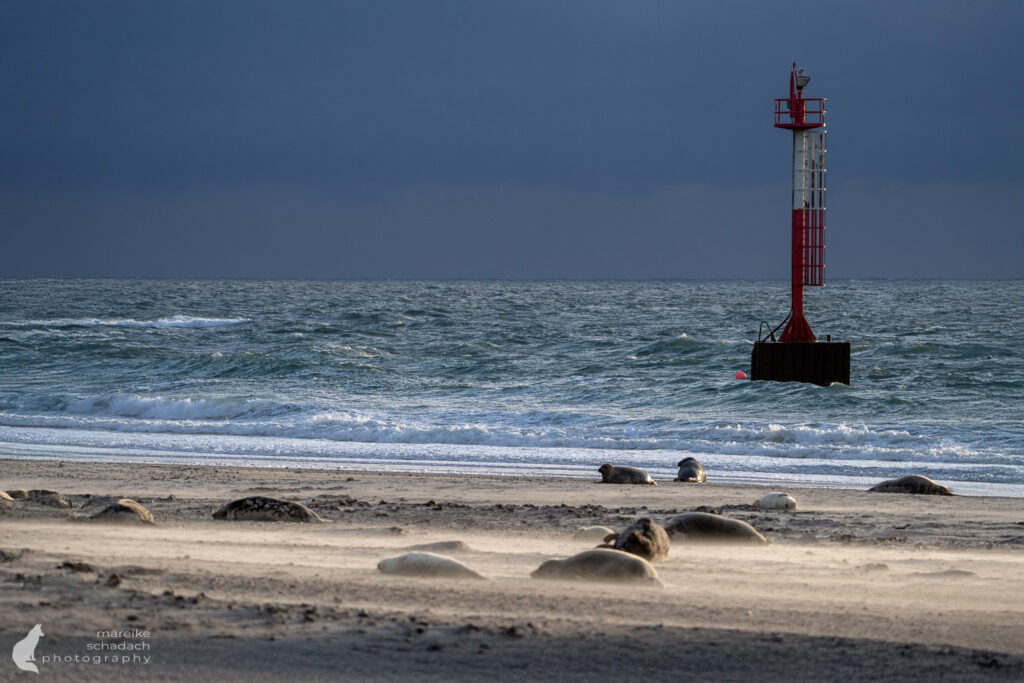
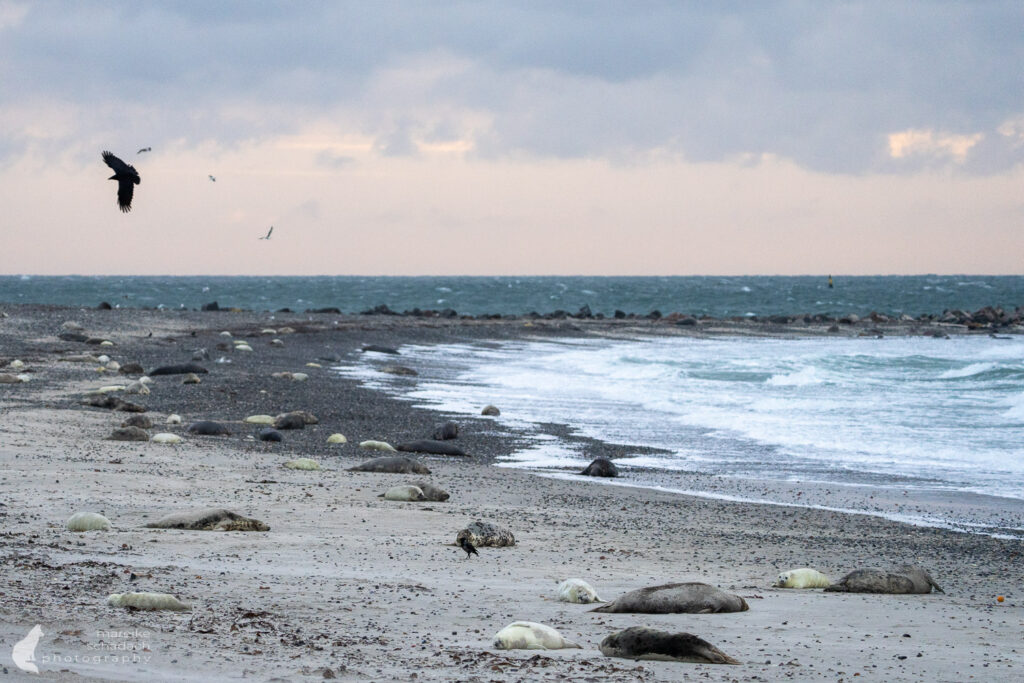
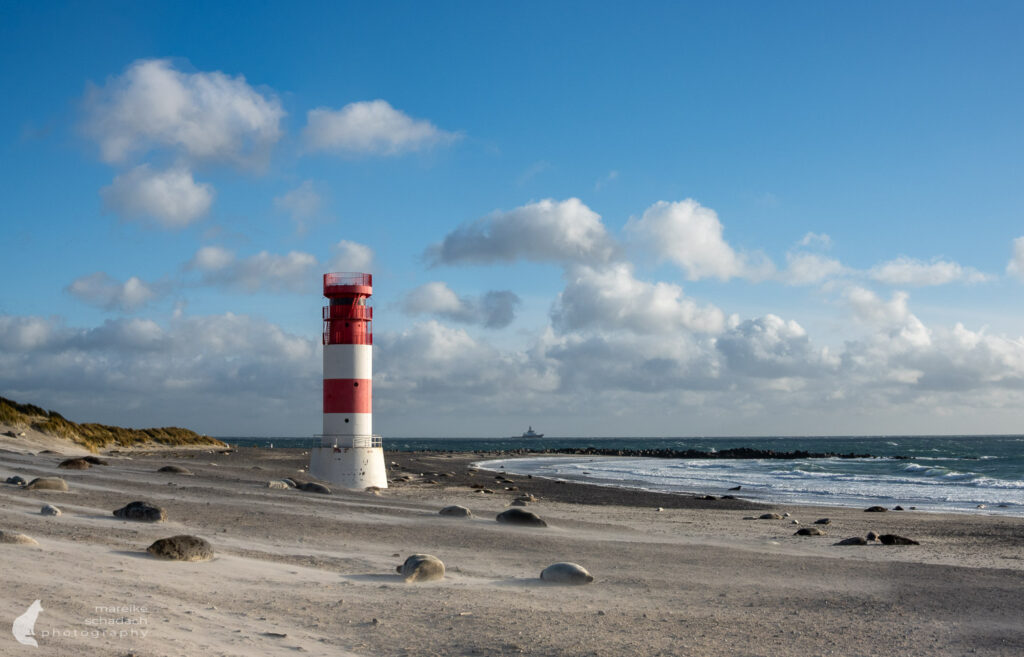
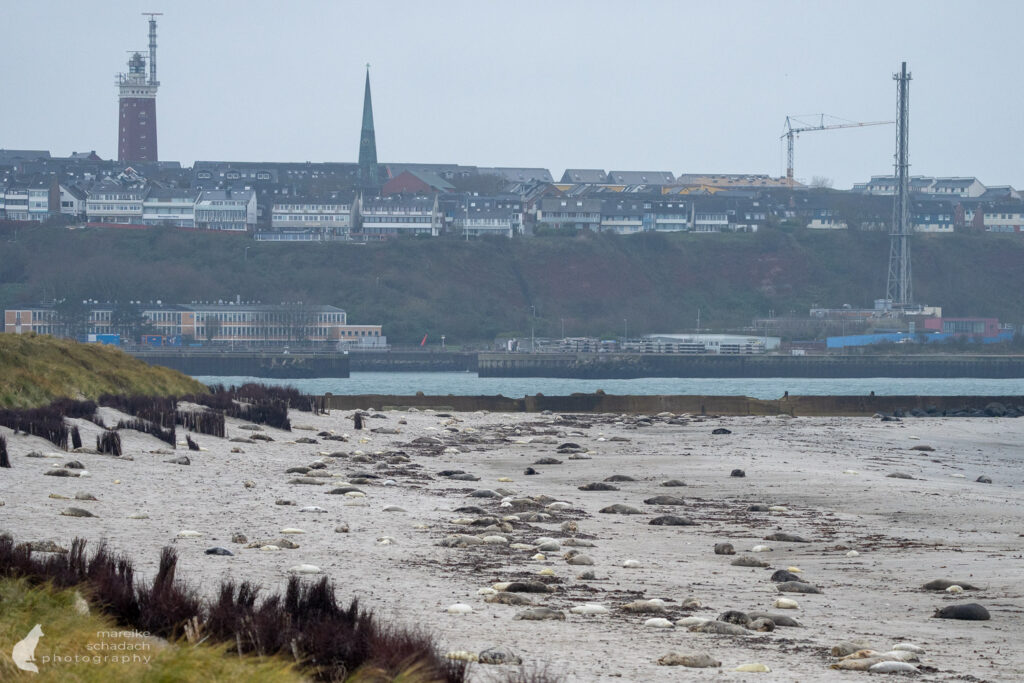
The gray seals often lie close together. Therefore, the beaches are closed to humans. It is no longer possible to walk on the beach without disturbing the seals or risking a bite. However, you can still observe the animals:
There is a raised wooden boardwalk in the dunes on the north beach. From here, you have a good view of the north beach. Some of the seals lie very close to or high up in the dunes. Sometimes they even crawl across the panoramic trail.
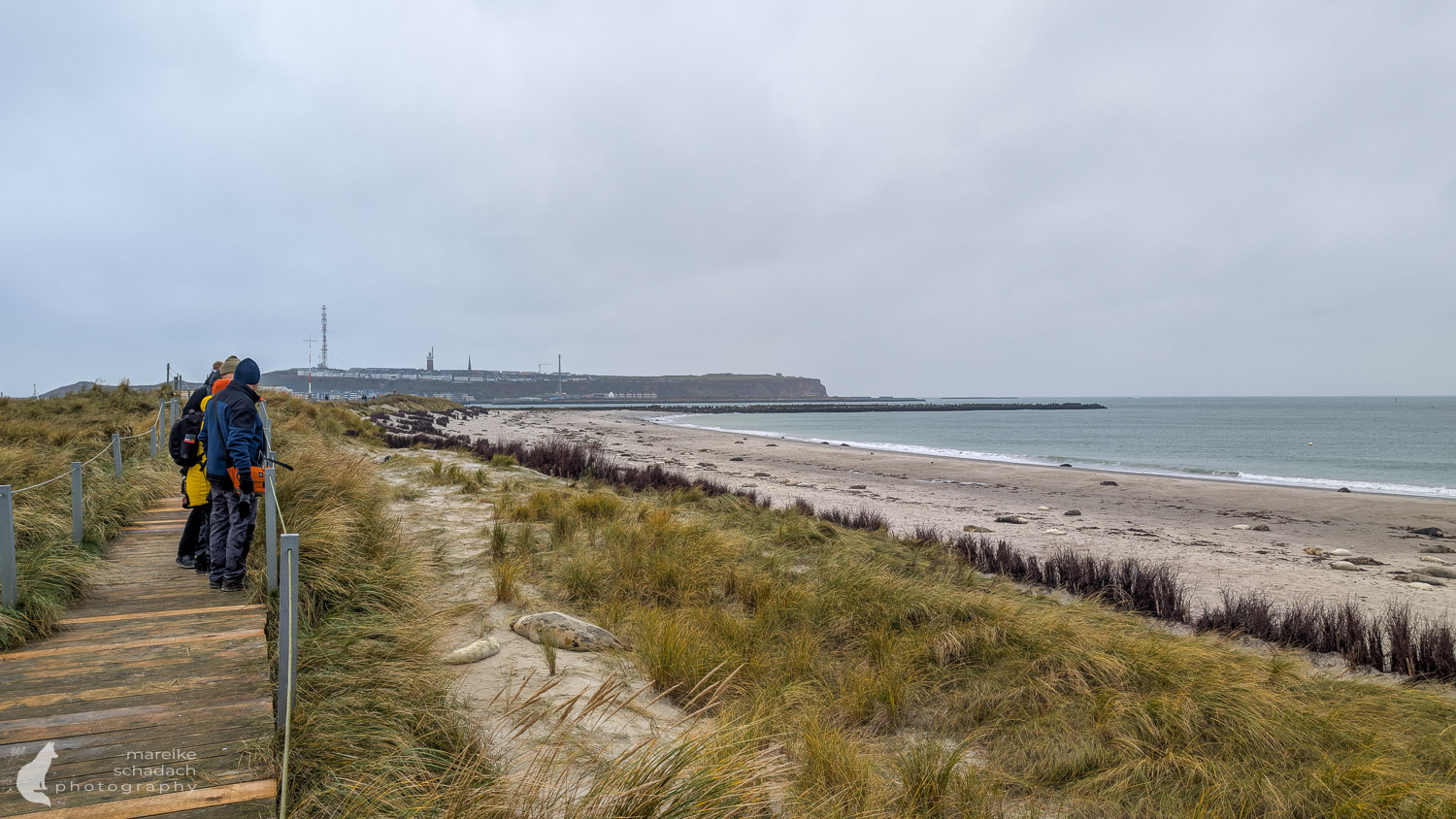
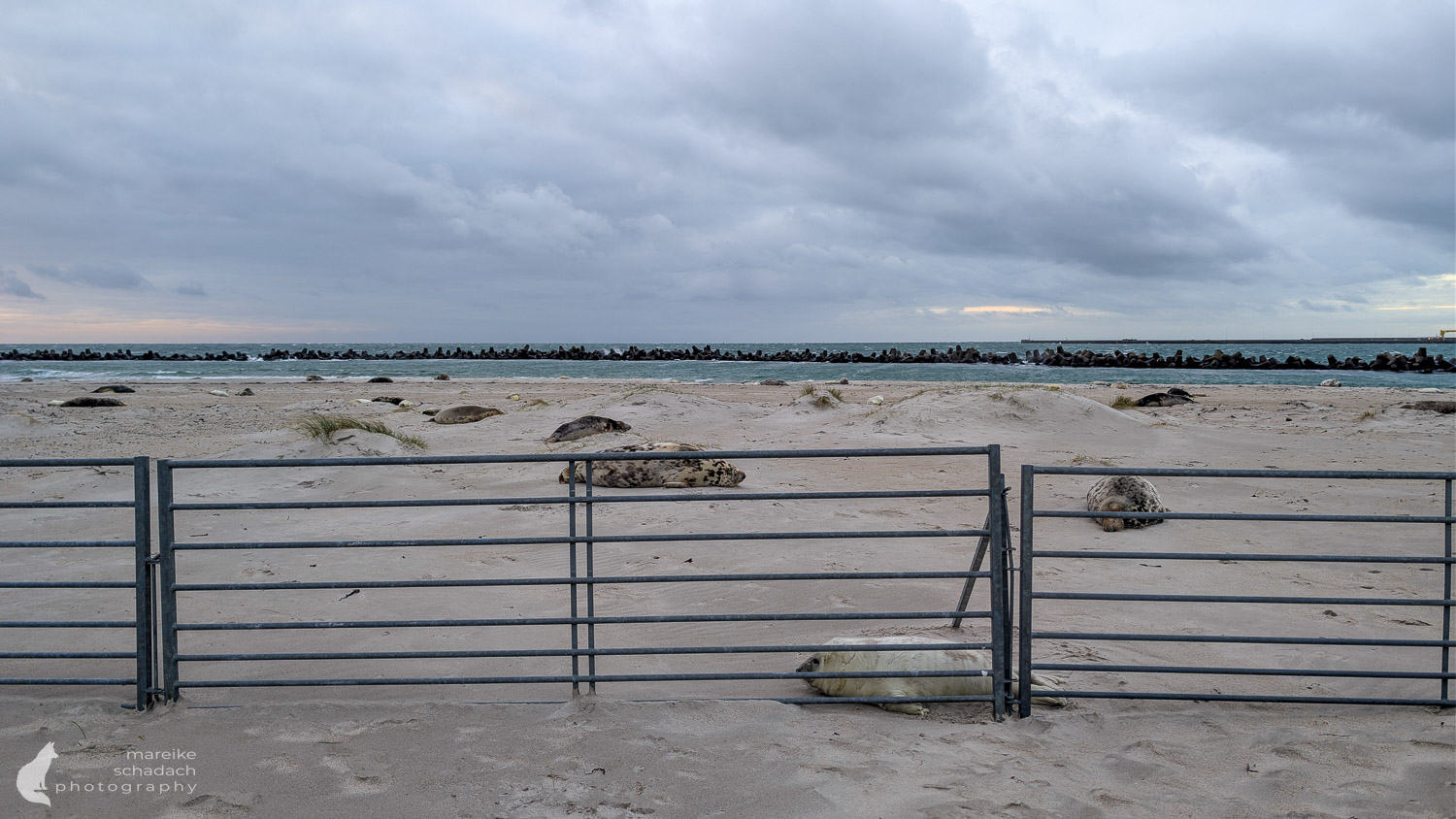
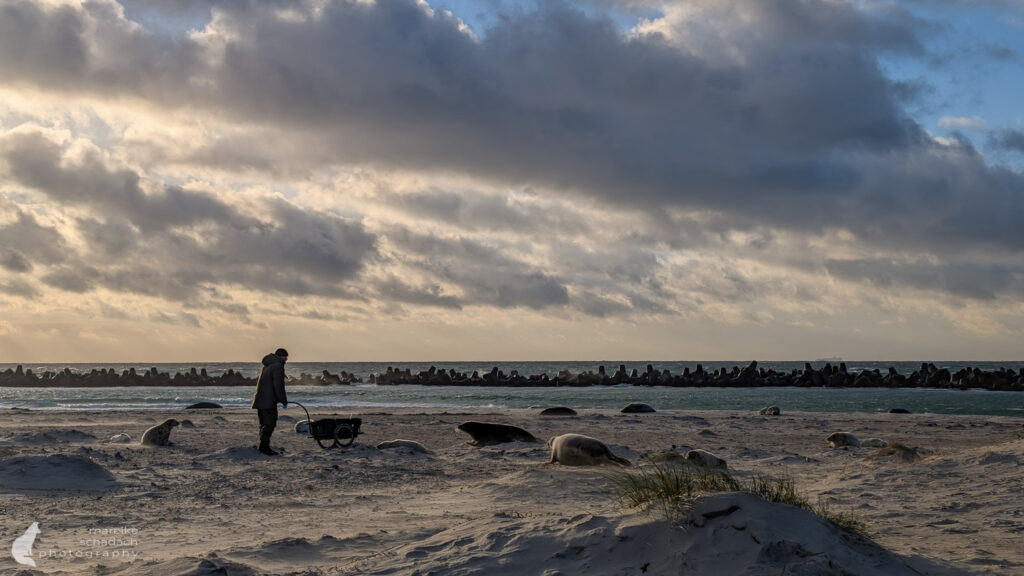
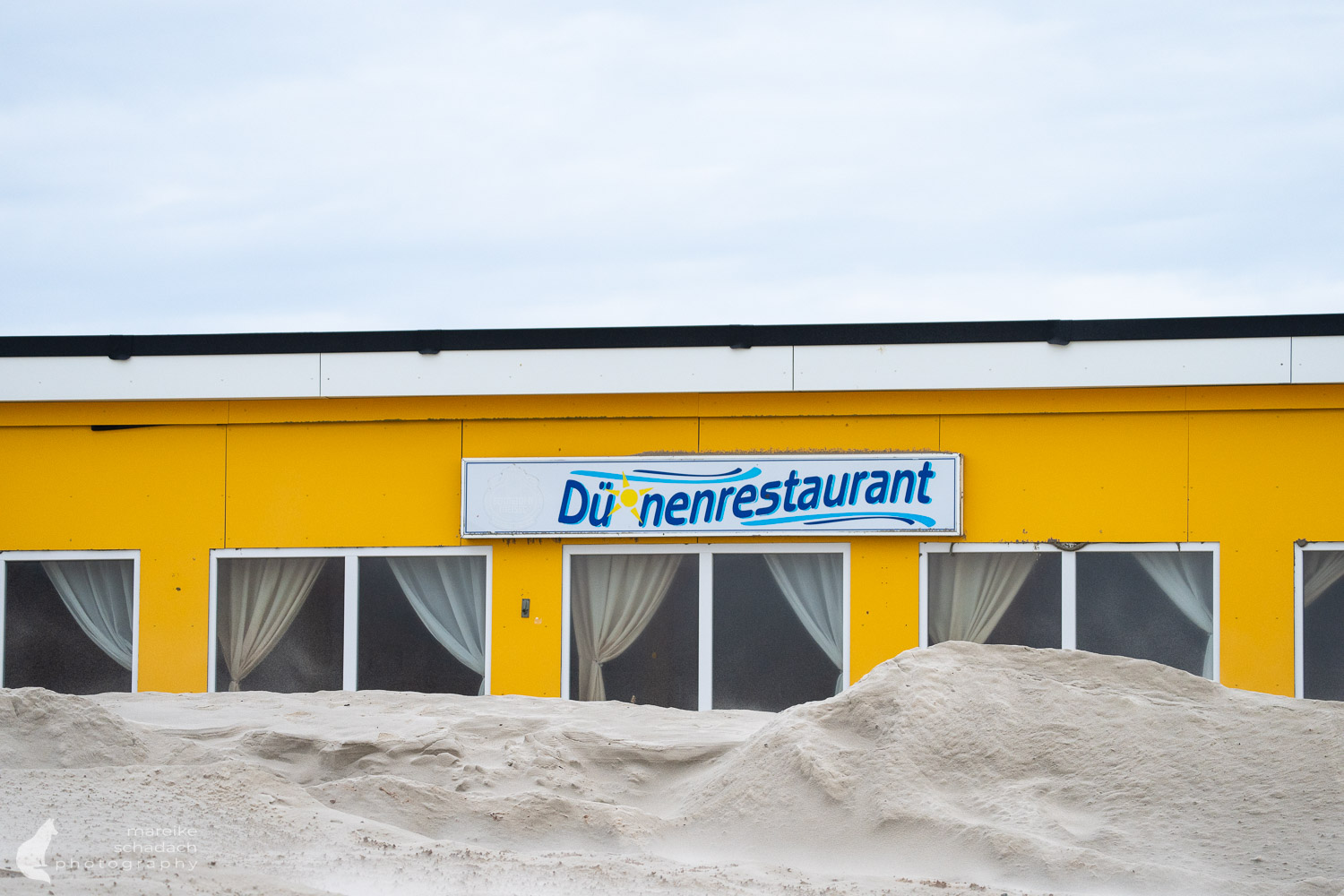
The southern beach is accessible up to the Düne restaurant (closed in winter) at the upper edge; the rest of the beach is separated by a sturdy metal fence. The seals are also spread out across the entire beach up to the fence. Despite the fence, it is important to keep your distance here as well, otherwise the animals will become restless or too accustomed to humans. This can become a problem in the following bathing season when the seals, accustomed to humans, get too close to bathers.
A Look back at the History of Heligoland
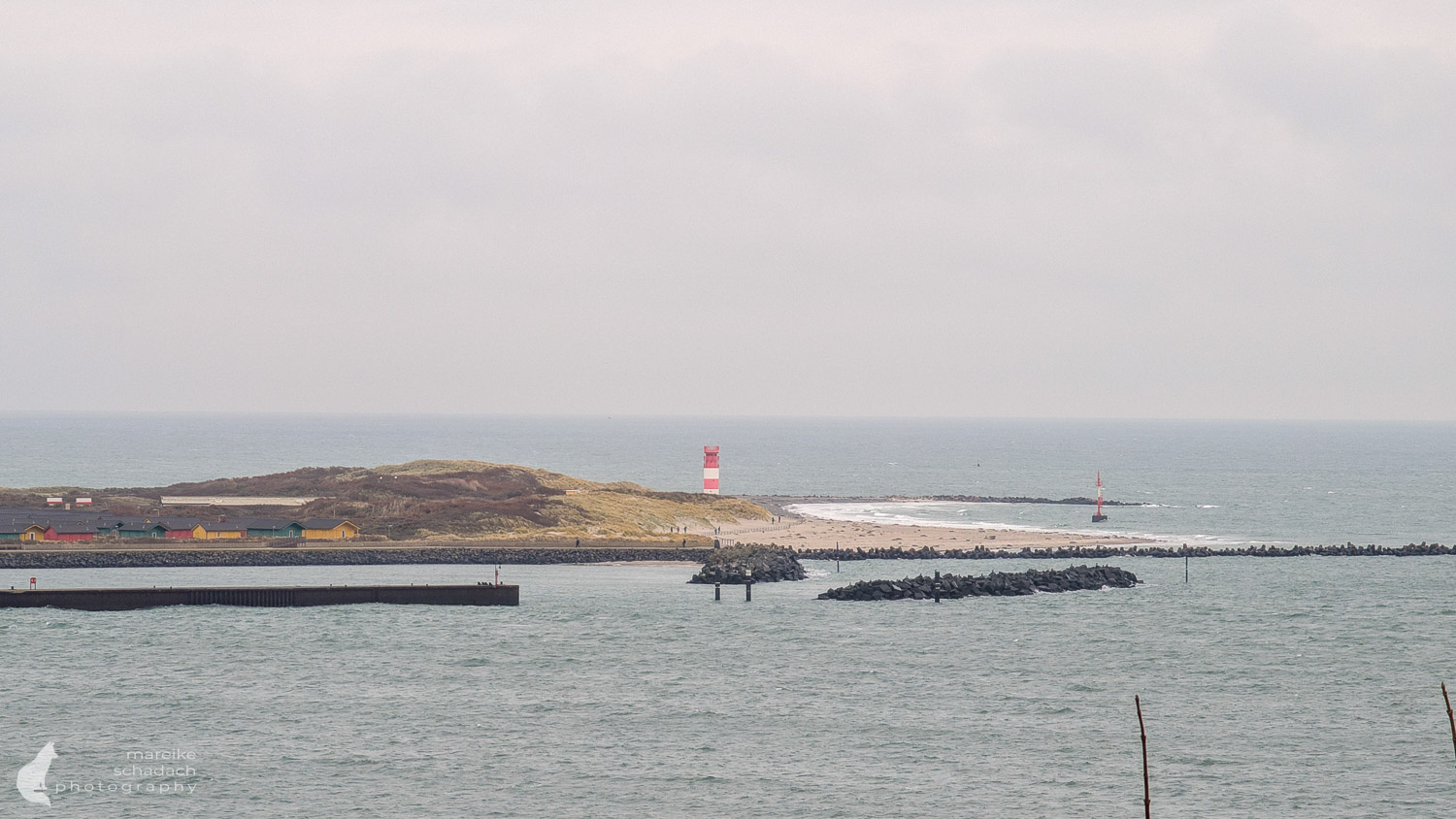
Heligoland and the neighboring island of Düne only acquired their current shape and size during the Nazi era. In order to develop Heligoland as a strategic naval port, both islands were to be greatly enlarged as part of the Hummerschere project. To this end, large parts of the present-day island were filled in and fortified so that their shape and size were no longer subject to the influence of the tides. This created the northeast and south harbor areas on the main island, and Düne was enlarged many times over, and the airport was built.
Gray Seals in Germany – A Success Story
Grey seals used to be mercilessly hunted in the North Sea – for their fur, their meat, and because of the mistaken belief that they were decimating fish stocks. By the beginning of the 20th century, gray seals had been almost wiped out in German waters. In addition to hunting, environmental toxins also caused their numbers to decline dramatically. It was only with strict protection under the Federal Nature Conservation Act, international agreements, and the designation of the Heligoland FFH area with the Heligoland rock base that the population began to slowly recover.
Since the first gray seal birth on Heligoland in the winter of 1996/97, there has been a steady increase in the number of births. Today, Heligoland is the most important breeding ground for gray seals in Germany—and one of the few places in Europe where you can observe the birth of these animals without endangering them. Today, around 1,000 pups are born here every year – and the trend is rising.
Total number of gray seal births (source: Verein Jordsand e.V.):
– 2024/25: over 1,000 pups
– 2023/24: 850-900 pups
– 2022/23: 700-800 pups
– 2021/22: 670 pups
– 2020/21: 652 pups
Life in the Colony – Closeness and Distance
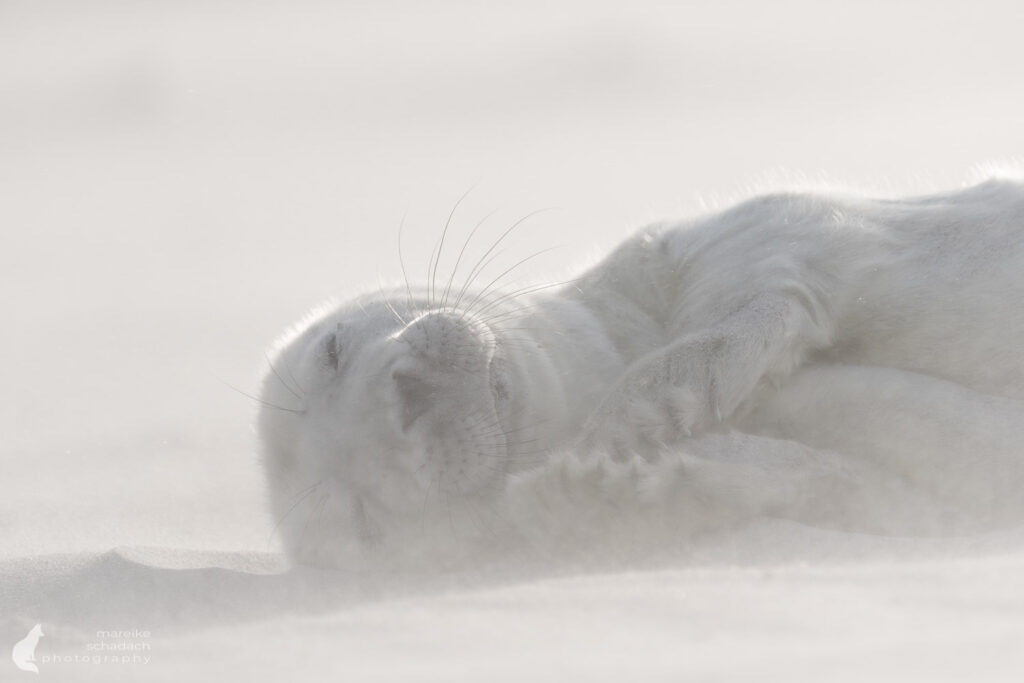
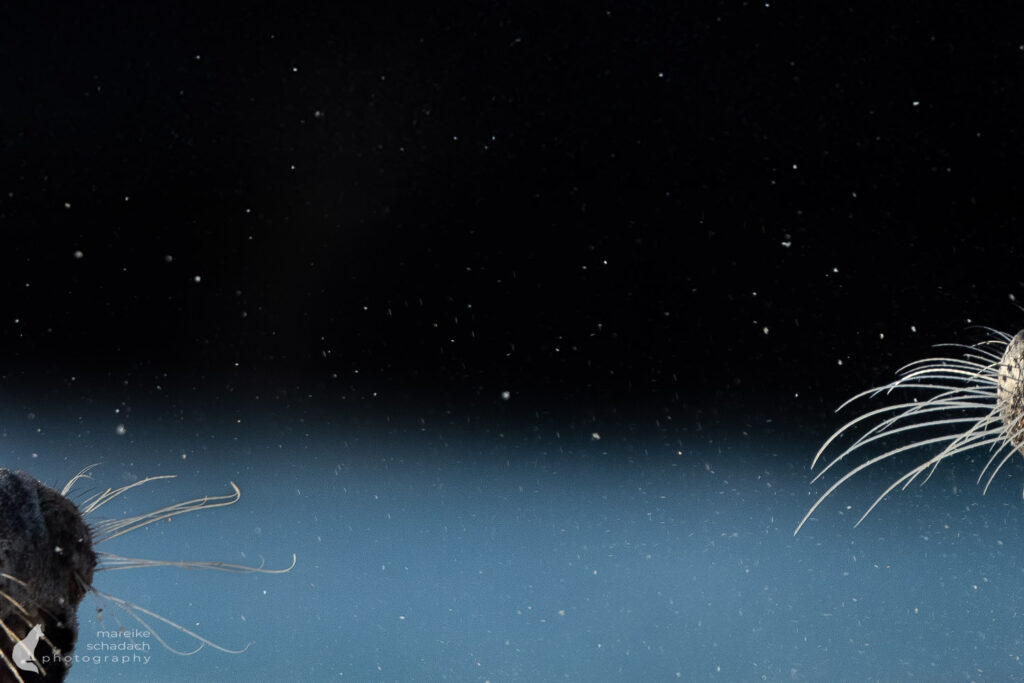
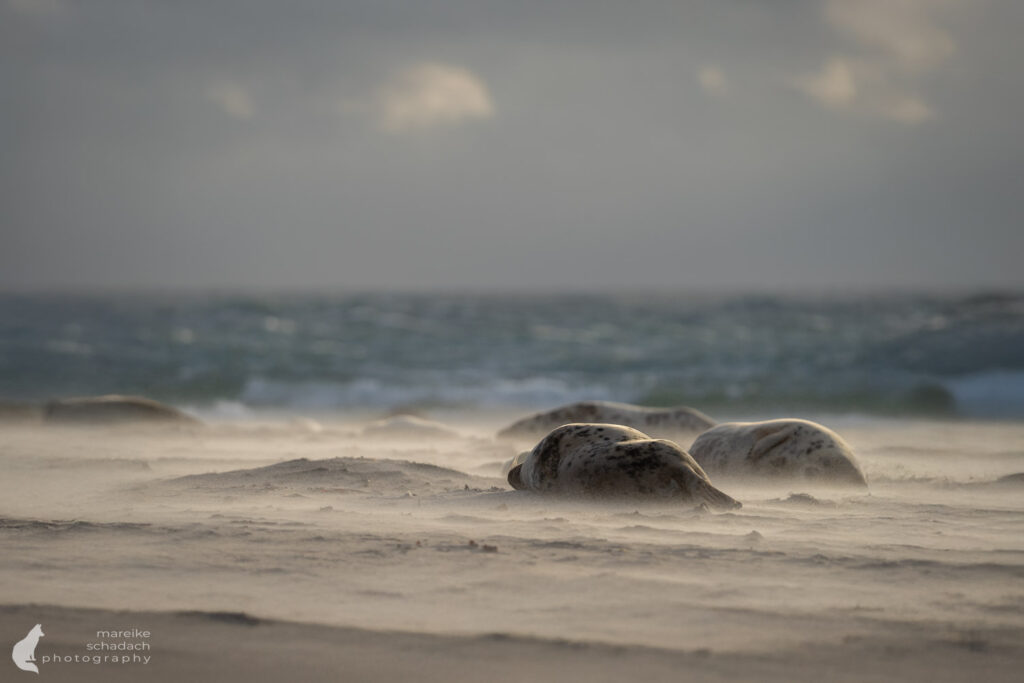
Wind blows sand across the beach, swirling around the animals like thin veils. But the seals seem unmoved by such moments: they close their eyes and let everything wash over them. There is a clear order among the adult animals: mothers keep their distance from each other, young animals lie scattered across a wide area, and males patrol the edges. Although the colony appears dense, the animals rarely touch each other.
The most common behaviors I observe are:
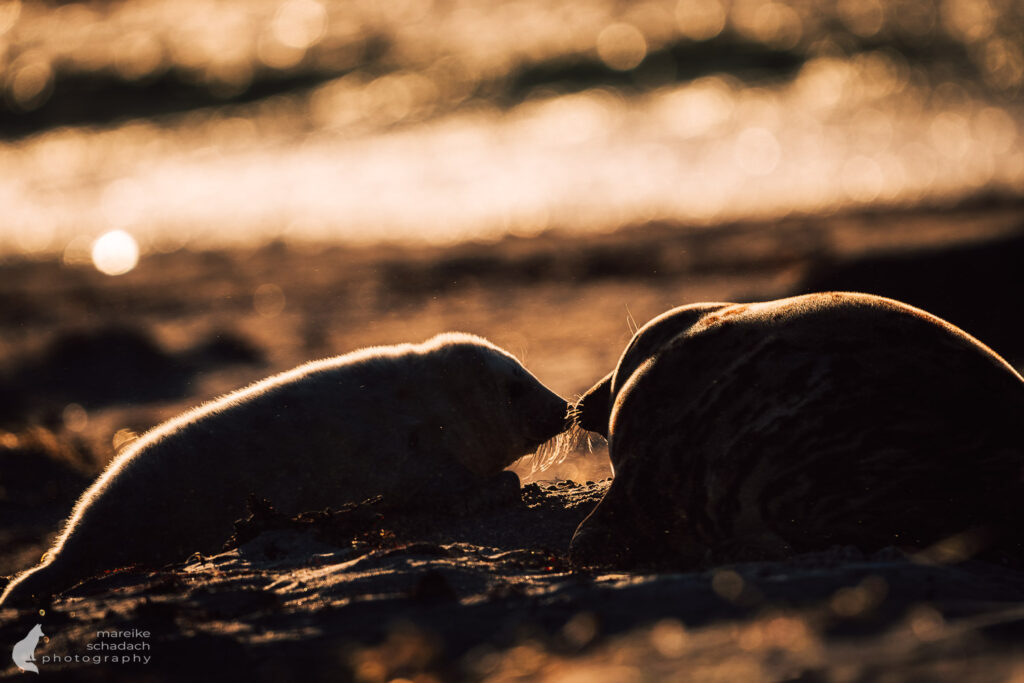
- Contact sounds between mother and pup, suckling, playful physical contact between pup and mother
- Protection of the pup from other seals
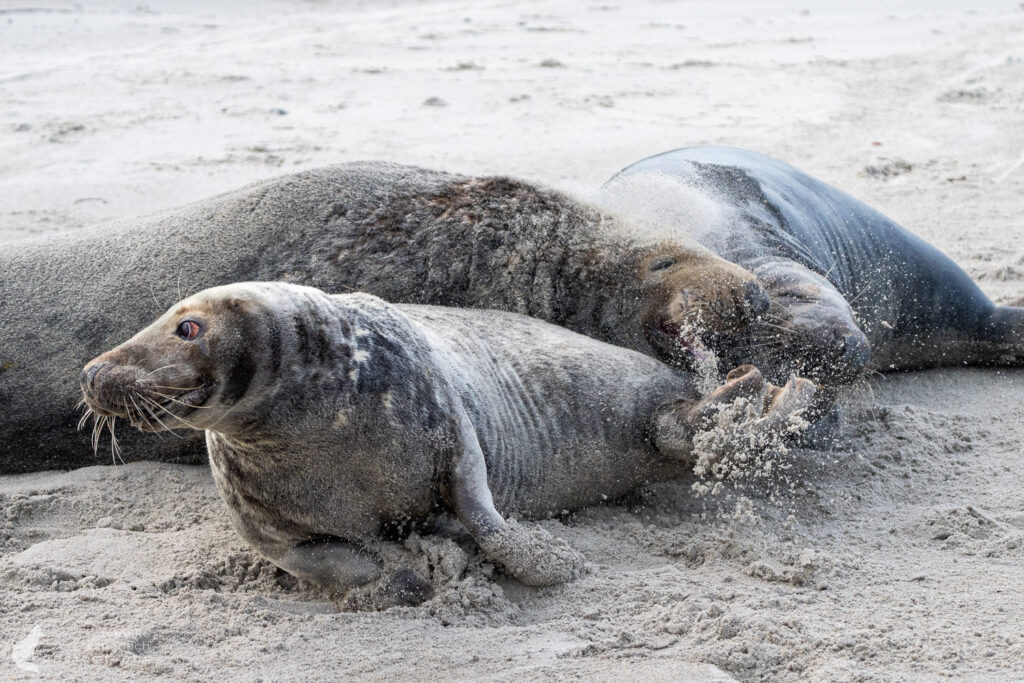
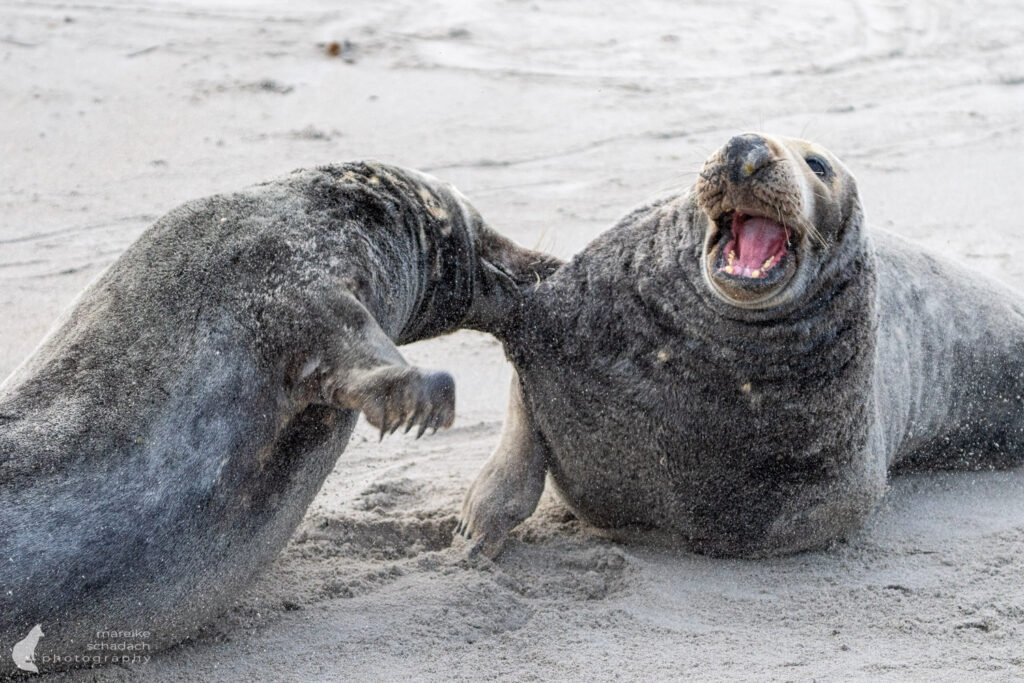
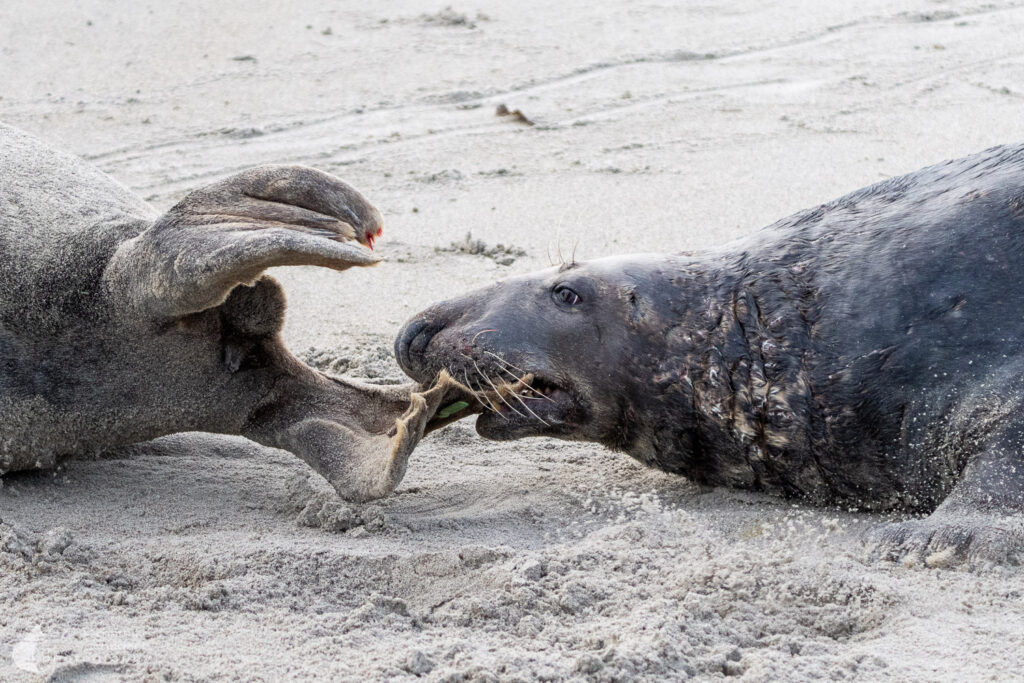
- Rearing up and threatening, especially between males, but also females, who attack each other if one comes too close.
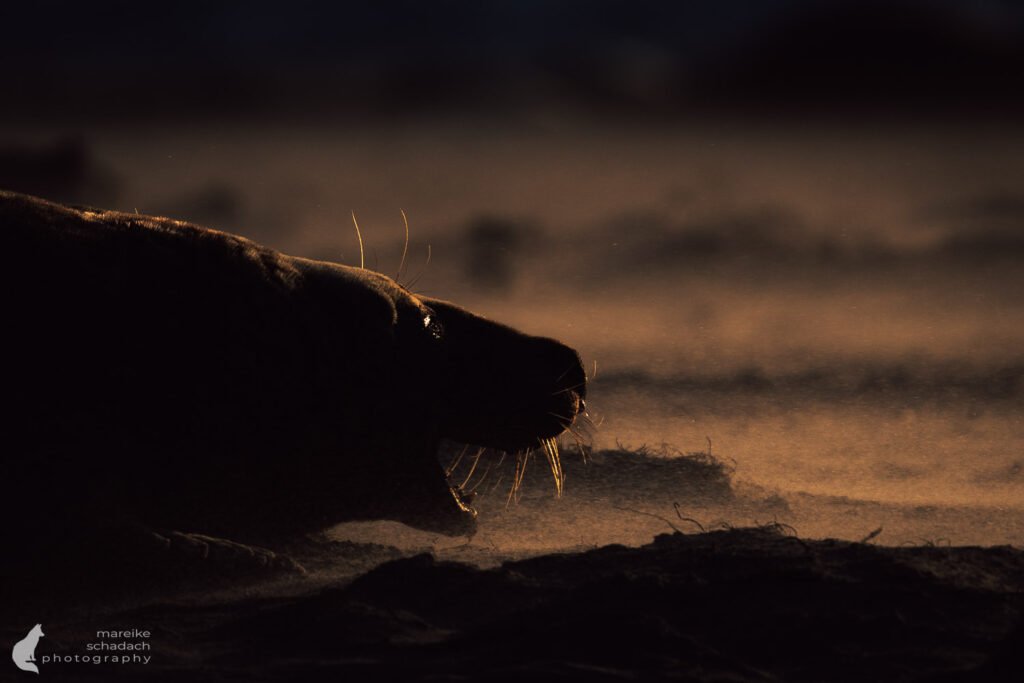
- Mock attacks, which often consist only of a low head position and open mouth
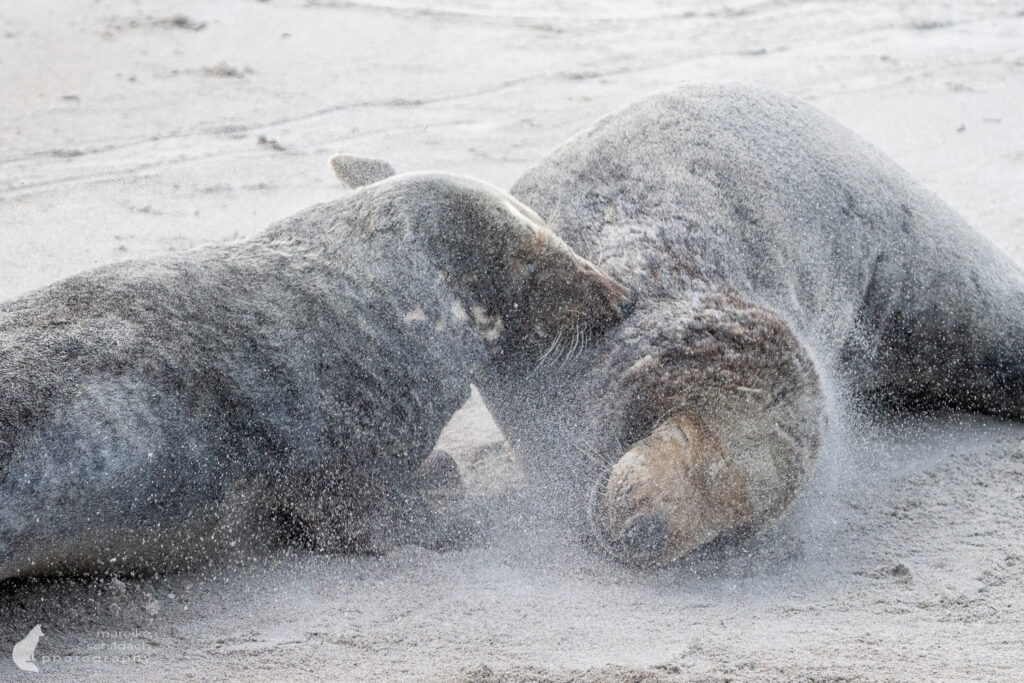
- Bloody fights between the bulls
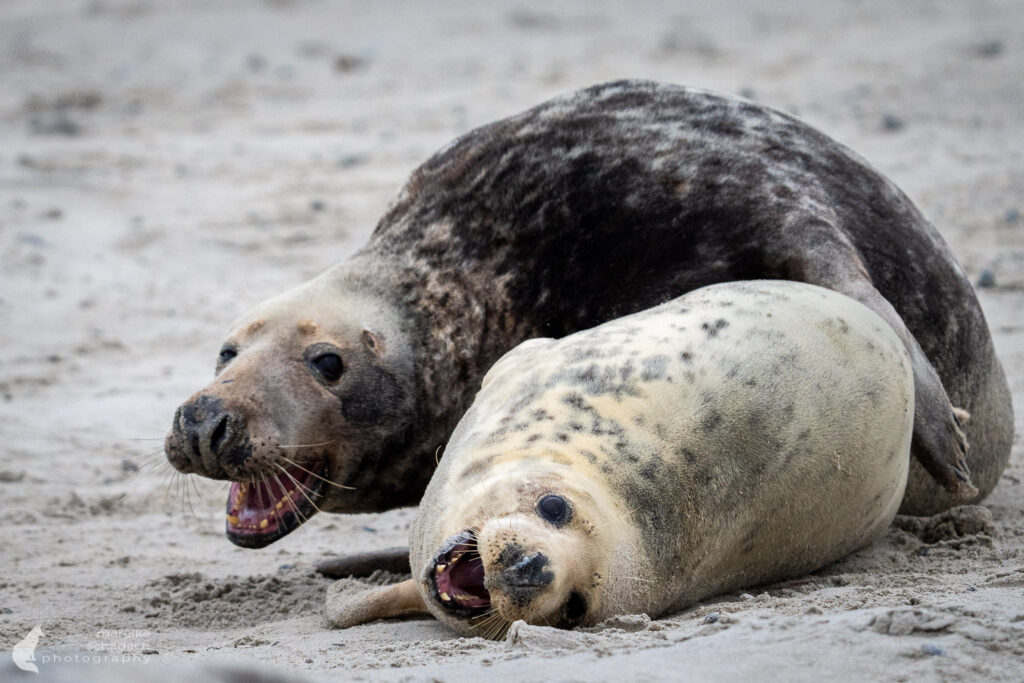
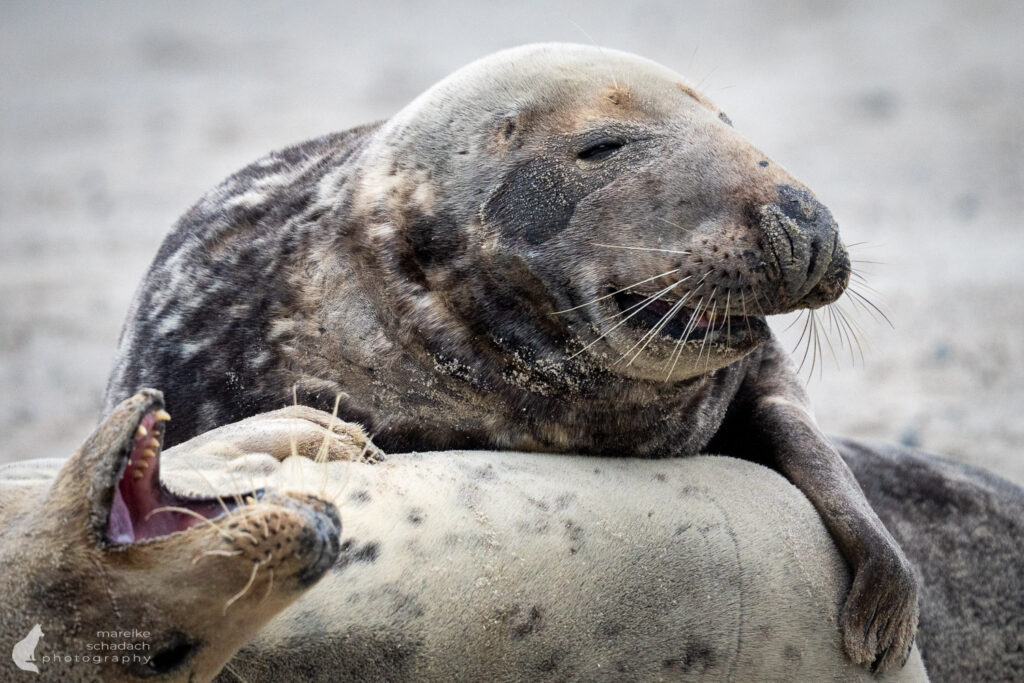
- The approach of the bulls to the females, because mating takes place immediately after weaning the young. Most of the time, the bulls are driven away, but I was able to observe mating twice.
Mating Season in Winter
While the young animals still lie awkwardly on the beach, the mating season begins for the adults. The males wait, observe, and show their presence. They keep a close eye on when one of their females is ready to mate. However, if the males approach the female too early, they are rudely rejected.
The stately bulls vehemently defend their harem (typically five to seven females) against intruders and competitors. Violent fights are rare – most rivalries are decided by body language, vocalizations, and mutual intimidation.
After successful mating, the fertilized egg enters a dormant period of around three months. Only then does the approximately eight-month embryonic development begin. This makes it possible for the birth to take place again in winter. By then, most females have built up enough energy reserves to nurse for several weeks.
The Moment that remains
As I leave the beach in the evening, the calf whose birth I witnessed is nestled close to its mother. Its fur is no longer wet and shines white. It looks around curiously, appearing full and content. The moment when the seal pup fell from the bursting amniotic sac onto the beach and lay there as a wet, helpless bundle in the sand-filled gusts of wind is burned into my memory.
Heligoland Dune shows its roughest side in winter. And at the same time it's most tender. New life grows here, and nature tells one of its oldest stories. Quiet. Wild. And every year anew.

How to behave around Gray Seals
Gray seals are Germany's largest predators and should be treated with respect and consideration. For the successful rearing of young animals and for your own safety, please note the following:
- Check with the rangers and staff of the Jordsands e.V. association about the current accessibility of the beaches and any restrictions in place.
- You may encounter seals outside the barriers. On freely accessible areas, be sure to keep a distance of 30 meters from the animals.
- Young animals that have been influenced by too close contact with humans can sometimes make safe and carefree swimming difficult in summer. They approach bathers fearlessly.
- Do not go near bull fights, as the animals can reach speeds of around 20 km/h on land and are particularly aggressive during the mating season.
- Do not block the animals' access to the water or from the water to land. Never get between a calf and its mother.
- Severe disturbances can permanently disrupt the sensitive bond between mother and calf, which can lead to high calf mortality in the first year of life.
Photography Tips for Gray Seals on Heligoland Dune
Access to the beach:
The beaches are largely closed during the breeding season. There is an elevated panoramic path on the north beach from which you can observe the seals, and on the south beach you can walk along the beach up to a metal fence separating it from the dune restaurant.
Perspective:
Since the gray seals lie on the ground, the best pictures are taken when you lie on the ground yourself. This is only possible on the south beach, where the metal fence is located.
Focal length:
I took most of the pictures with a 200-600 mm telephoto lens. Unfortunately, the lens end was too large in diameter, so I couldn't use the metal fence as a tripod substitute. However, I was still able to take good pictures, even close to the ground. The 100-400 mm lens would have been better suited. A standard lens is definitely worthwhile for photographing the landscape and the seals in their habitat.
Best time to travel:
The birthing season lasts from November to January. When I was on Heligoland Düne at the beginning of December, around 700 pups had already been born, and there were many different age groups. The best chance of seeing a birth is at the end of November.
Best time of the day:
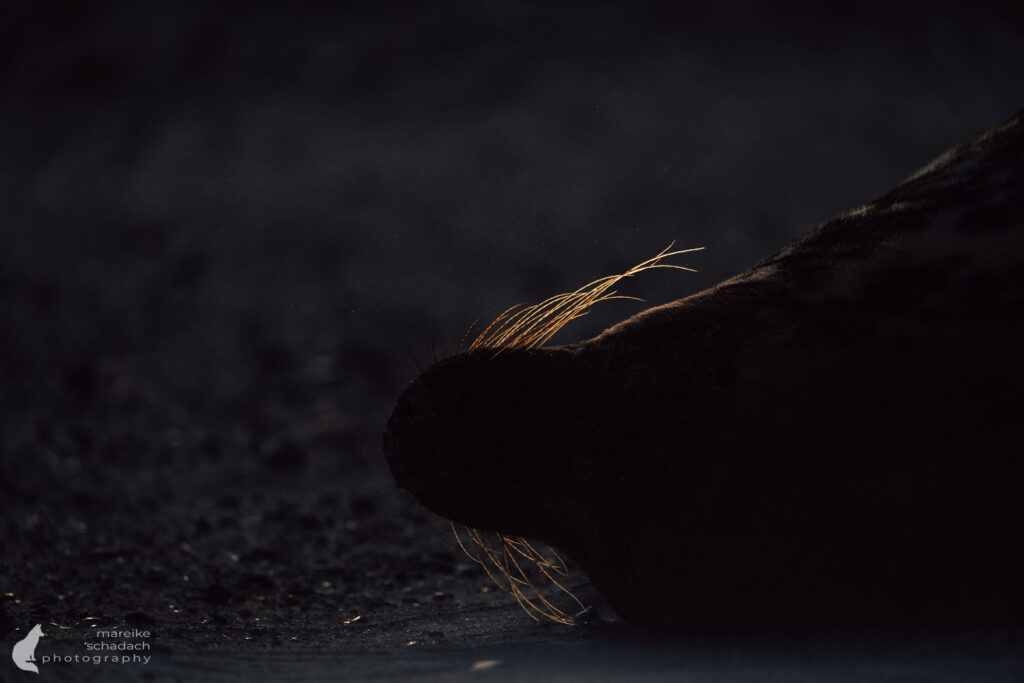
I couldn't detect any different activity patterns among the gray seals throughout the day, but it is said that they are most active in the morning. In addition, the morning and evening are particularly beautiful because of the beautiful light. This allows you to take beautiful backlit shots in the morning
Sand and rain:
Sand blows most near the ground, and it is almost impossible to prevent it from getting on your camera. If you like, bring a protective cover and UV filter. A brush has proven useful for brushing off sand grains at the end of the day.
Food, warming up, toilet:
Bring everything you need for food and drink. Drinking water can be refilled in the toilets in the heated exhibition/lounge area at the ferry terminal. There are also power outlets and tables for lunch breaks.
Getting to the dunes:
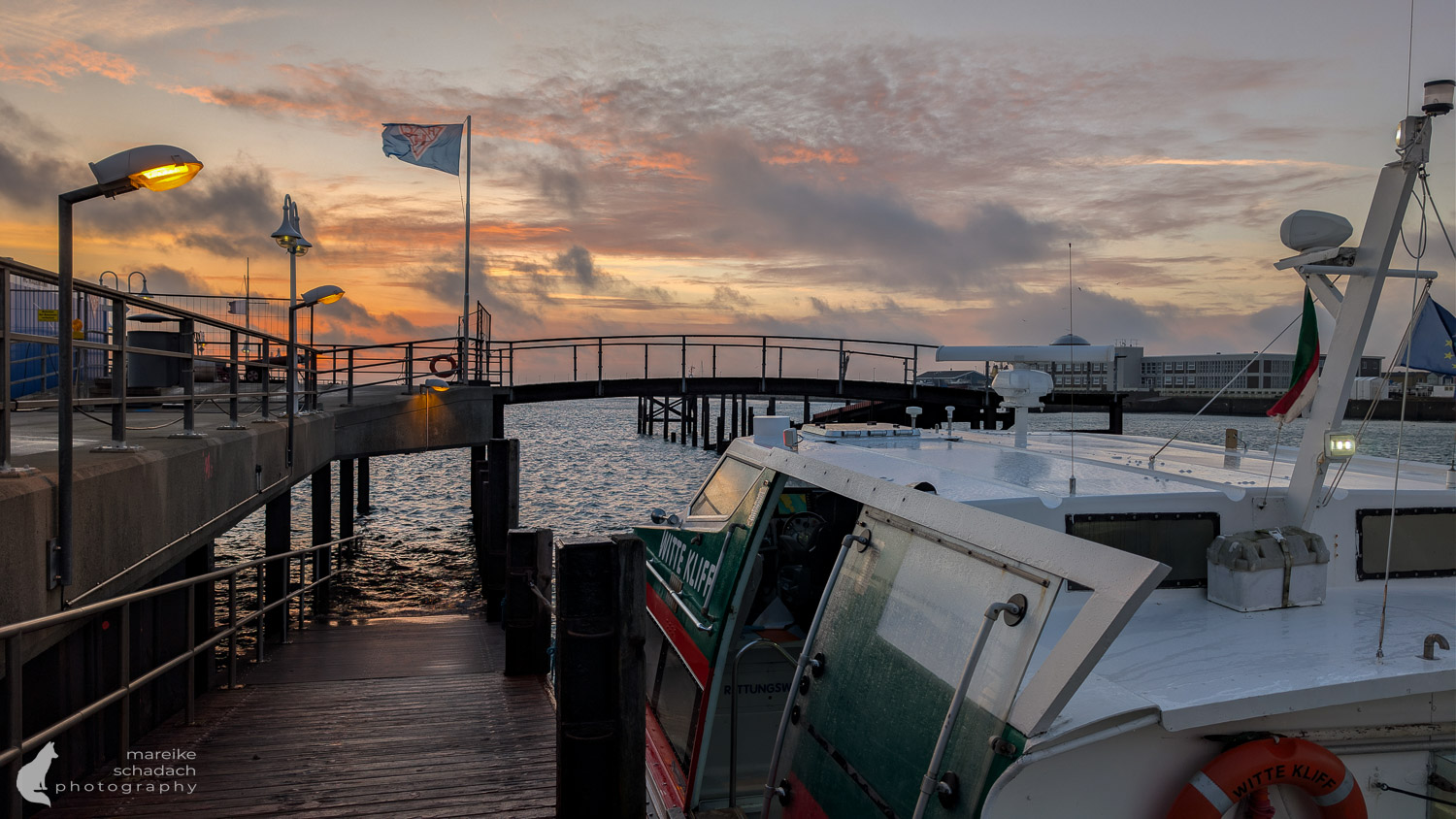
The first dune ferry leaves at 8 a.m. at the beginning of December, and a round trip costs €6. More information here.
Book Recommendations for Nature Lovers
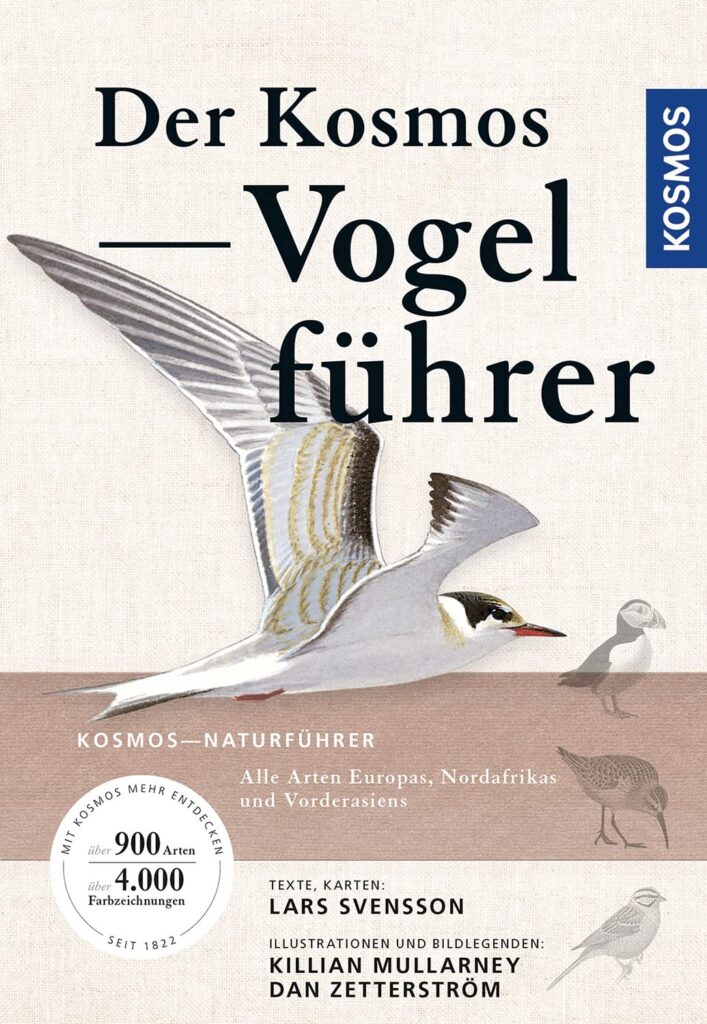
Would you like to learn more about wildlife observation? Then I have three book recommendations for you. You can order the books* from Amazon by clicking on the images. If you buy a book or another article via an affiliate link, I will receive a small commission, and you will help me to continue to fill Wanderlust Motifs with interesting articles. The product will not be more expensive for you.


Want to know when there are new articles on my blog? Then follow me on Facebook, Pinterest or Instagram. I am also very happy if you share my article with your friends.